Life Safety Systems · Comparison
Addressable vs Conventional Fire Alarm Panels
An addressable fire alarm panel pinpoints the exact device in alarm. A conventional system only knows the zone. That single difference reshapes cost, response time, and integration.
An addressable fire alarm panel is a control unit in which every detector, call point, and module carries a unique digital address — allowing the panel to identify the exact device in alarm, not just the zone. Conventional fire alarm panels, by contrast, detect alarms only at the zone level.
This guide compares both architectures across nine technical and commercial dimensions: system design, code compliance, total cost of ownership, and the facility profiles where each is the correct engineering choice.
What Is an Addressable Fire Alarm Panel?
An addressable fire alarm panel is a microprocessor-based control unit that communicates digitally with every initiating device on its signaling line circuit (SLC). Each device — smoke detector, heat detector, manual call point, input or output module — is assigned a unique address, typically from 1 to 254 per loop.
When a device enters alarm, pre-alarm, or fault, the panel polls its address and displays the exact location, device type, and status. Operators see “Smoke alarm — Detector L1.D42 — Server Room B — Floor 3,” not just “Zone 7 active.”
Core Components
- Control panel — houses the CPU, power supply, and SLC drivers. Blue BMS supplies Autronica addressable fire alarm panels for industrial and marine applications.
- Signaling Line Circuit (SLC) — digital loop carrying both power and data.
- Addressable devices — detectors and call points with onboard electronics and unique IDs.
- I/O modules — interface conventional devices or trigger suppression, HVAC, access control.
- Isolators — short-circuit fault isolators protecting loop segments from cascading failure.
What Is a Conventional Fire Alarm System?
A conventional fire alarm system monitors groups of devices wired in parallel on dedicated zone circuits. Each zone represents a physical area — a floor, wing, or room cluster — and the panel can only indicate which zone triggered, not which device.
Detection logic is analog: when any device in a zone draws enough current, the panel registers the zone as active. There is no digital handshake between panel and device.
Core Components
- Control panel — zone supervision, alarm indication, notification circuits.
- Zone circuits — Class B or Class A loops, each with an end-of-line resistor.
- Initiating devices — smoke, heat, and manual stations without onboard intelligence.
- Notification Appliance Circuits (NAC) — power horns, strobes, and bells.
Addressable vs Conventional: Side-by-Side
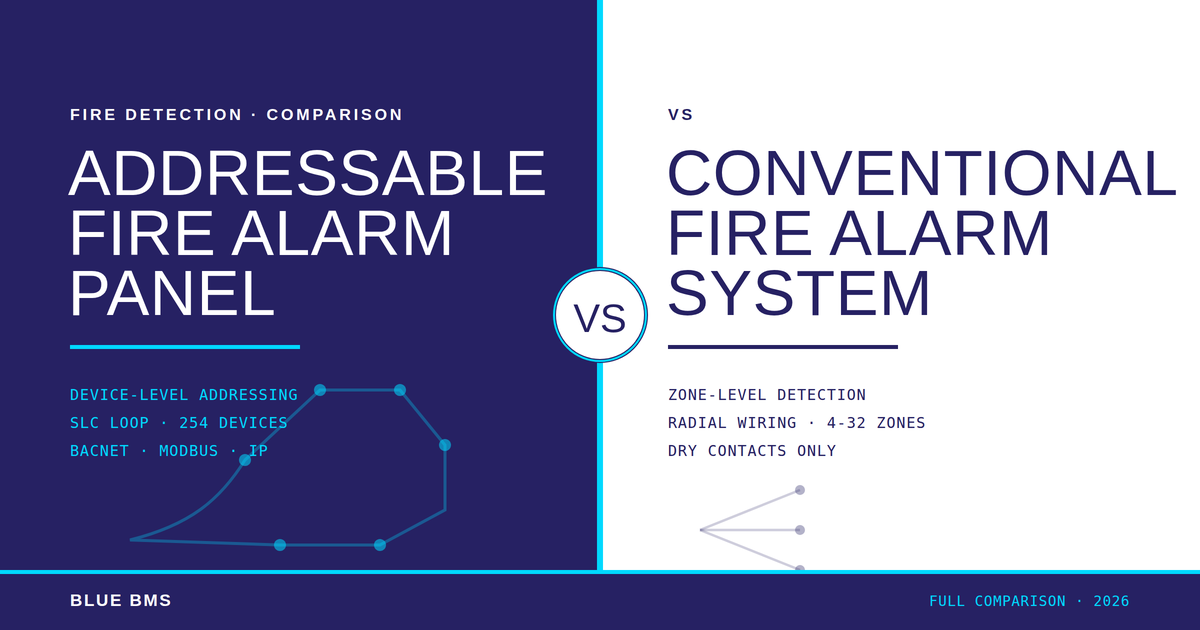
The most-referenced section for procurement teams and consulting engineers — every practical difference between an addressable fire alarm panel and a conventional system in one view.
| Criterion | Addressable Panel | Conventional System |
|---|---|---|
| Detection granularity | Individual device | Zone only |
| Communication | Digital, two-way polling | Analog current change |
| Device capacity | 127–254 per loop, multi-loop | 4–32 zones per panel |
| Wiring topology | Single loop (Class A/X) | Radial Class B per zone |
| Total cable | Less (loop architecture) | More (one run per zone) |
| Pre-alarm / drift comp | Yes | No |
| False alarm rate | Lower (multi-criteria) | Higher (fixed thresholds) |
| Fault isolation | Per-device, with isolators | Whole zone lost on fault |
| Maintenance | Remote diagnostics | Manual walk-down |
| Integration (BMS/gas) | Native BACnet/Modbus | Dry contacts only |
| Upfront hardware cost | 30–60% higher | Lowest entry cost |
| Installation labor | Lower | Higher |
| 10-yr TCO | Lower > 10,000 sq ft | Lower < 5,000 sq ft |
| Best-fit facility | Mid–large, mission-critical | Small, single-tenant |
| Compliance | NFPA 72, UL 864, EN 54 | NFPA 72, UL 864, EN 54 |
Fig. 1 — Addressable fire alarm panel vs conventional system, 2026.
System Architecture & Wiring Topology
Conventional: Zone-Based Radial Circuits
A conventional system uses Class B wiring with dedicated home-run circuits per zone, terminated by an end-of-line resistor (typically 4.7 kΩ to 10 kΩ). A 24-zone building requires 24 separate cable runs back to the control room — a heavy material and labor burden in vertical installations.
Addressable: SLC Loop Architecture
An addressable fire alarm panel uses a single signaling line circuit that leaves the panel, threads through all loop devices, and returns (Class A). One pair of conductors can supervise up to 254 devices across a floor. Under NFPA 72 Chapter 23, Class A loops also keep operating if a single wire break occurs, polling devices from both ends.

Detection Speed & Diagnostic Granularity
Conventional panels report a binary state per zone: normal, alarm, or fault — no sensor-health insight, no drift compensation, no pre-alarm. Addressable systems poll every device every 2 to 5 seconds, reporting analog values and history. For a deeper look at how these circuits are documented, see our guide to decoding the fire alarm system wiring diagram. Three capabilities follow:
- Pre-alarm thresholds — a supervisory warning before full alarm. Critical in clean rooms, data centers, and museums.
- Drift compensation — sensitivity auto-recalibrates as sensors age, extending life and cutting nuisance alarms. The same principle applies to gas sensors — see our troubleshooting guide on why ammonia sensors drift and how to fix it.
- Device-level diagnostics — a dirty detector is reported by address, so technicians target maintenance instead of inspecting the whole building.

Granular addressability is no longer a luxury feature. Above 25,000 square feet, operational savings from device-level diagnostics typically repay the addressable premium within four to six years.
Scalability & Loop Capacity
Modern addressable fire alarm panels support 127 to 254 devices per loop, and multi-loop panels manage 2 to 32 loops — a single networked architecture can supervise over 8,000 devices across a campus or high-rise.
Conventional panels are bounded by physical zone cards. Adding a 25th zone to a 24-zone panel typically demands a new panel or costly expander plus dedicated wiring. Outgrowing zone capacity means hardware replacement.
Cost Breakdown & Total Cost of Ownership
Cost must be assessed across the full lifecycle, not by panel sticker price.
Upfront Hardware
An addressable panel costs 30% to 60% more than a conventional panel of equal capacity. Addressable detectors carry a 2x–3x premium due to onboard electronics.
Installation & Cable
Addressable systems use 40% to 70% less cable for an equivalent facility, with installation labor 20% to 30% lower per device — especially in vertical buildings.
Lifecycle Maintenance
A 2024 Fire Protection Research Foundation benchmark found addressable systems cut annual inspection hours by 35% to 50% above 50,000 square feet, because technicians target drifting detectors directly.
TCO Crossover
Below ~5,000 sq ft, conventional wins on 10-year TCO. Above ~10,000 sq ft, addressable is the lower-cost choice. Between the two, device density and integration needs decide. For facilities running fire suppression systems for Tier III data centers alongside detection, the addressable premium is typically absorbed even faster, since both systems share the same digital backbone.

Code Compliance: NFPA 72, UL 864, EN 54
Both addressable fire alarm panels and conventional systems can be listed to the same standards:
- NFPA 72 — U.S. design, installation, inspection, testing, maintenance.
- UL 864 — product safety listing for U.S. control units.
- EN 54-2 / EN 54-4 — European control equipment and power supply standards.
- FM Approval — frequently required for industrial, oil & gas, and offshore.
Selection is therefore an engineering and economic decision, not a compliance one — though authorities increasingly favor addressable systems for high-occupancy, mission-critical applications. For a full breakdown of compliance and risk factors in heavy industry, see our guide to fire detection systems for industrial facilities.
Integration with BMS, Gas Detection & Suppression
This is where the architectures diverge most — and the primary driver for industrial buyers evaluating fire detection alongside gas detection, suppression, and Building Management Systems.
Conventional: Dry Contacts Only
Conventional panels expose alarm and fault states via dry-contact relays. Integration is binary — open or closed. No metadata, no device ID, no two-way command.
Addressable: Native Digital Integration
Modern addressable panels expose their full event stream over BACnet/IP, Modbus TCP, or vendor protocols, enabling:
- Real-time BMS graphics — floor plans with device-level alarm status.
- Cross-system cause & effect — a confirmed flame alarm can trigger suppression, shut HVAC, unlock egress, and route emergency lighting in one coordinated sequence. Det-Tronics gas and flame detectors integrate natively on the same addressable loop.
- Unified dashboards — fire, gas, HVAC, and access control in one view.
- Historical analytics — drift trends, false-alarm patterns, inspection records logged centrally.
For oil & gas, offshore platforms, data centers, and pharmaceutical manufacturing, the integration depth of an addressable panel is typically non-negotiable. See our guide on why intelligent Building Management is non-negotiable in high-risk environments for protocol mapping and cause-and-effect programming examples.

When to Choose Each System
Choose Addressable When
- Facility exceeds ~10,000 sq ft or three floors
- Device count is above 30
- BMS, gas, or suppression integration is required
- Site is mission-critical: data center, hospital, oil & gas, offshore
- False alarms carry high operational cost
- Multi-tenant occupancy needs precise alarm location
- Future scalability is a requirement
Choose Conventional When
- Facility is under 5,000 sq ft with simple zoning
- Device count is under 30 and stable
- Like-for-like retrofit with intact wiring
- Capital budget is tightly constrained
- No integration is required
- Application is low-complexity: small retail or office
Frequently Asked Questions
What is an addressable fire alarm panel?
A control unit where every connected device has a unique digital address, letting the panel identify the exact location of an alarm or fault at the device level rather than only by zone.
What is the main difference between addressable and conventional panels?
Conventional panels detect by zone — a group of devices on a shared circuit — while addressable panels detect at the individual device level, with two-way digital communication, pre-alarm states, and granular fault reporting.
Are addressable panels more expensive than conventional?
Upfront, yes — typically 30% to 60% more. But less cabling, fewer field hours, and lower maintenance produce lower total cost of ownership above approximately 10,000 square feet.
When should I choose a conventional system?
For small facilities under 5,000 sq ft, single-tenant buildings under 30 devices, like-for-like retrofits with intact wiring, and budget-constrained projects with no integration needs.
Do addressable panels comply with NFPA 72?
Yes. Both addressable and conventional panels can be certified to NFPA 72, UL 864, and EN 54-2/4. The choice is driven by facility size and requirements, not compliance.
Can I integrate an addressable panel with a BMS?
Yes — via BACnet, Modbus, or vendor protocols, connecting to BMS, gas detection, HVAC, and access control. Conventional panels offer only dry-contact outputs, which limits integration depth.
How many devices can one addressable panel monitor?
Typically 127 to 254 per signaling line circuit loop, with multi-loop panels managing 2 to 32 loops — a networked architecture can supervise more than 8,000 devices.
Specify the Right Fire Detection System
Blue BMS designs, supplies, and commissions addressable and conventional fire alarm systems for industrial, commercial, and mission-critical environments — across oil & gas, offshore, data centers, and BMS-integrated facilities.
Blue BMS — Fire Detection
Life Safety Systems · Comparison
Addressable vs Conventional Fire Alarm Panels
An addressable fire alarm panel pinpoints the exact device in alarm. A conventional system only knows the zone. That single difference reshapes cost, response time, and integration.
An addressable fire alarm panel is a control unit in which every detector, call point, and module carries a unique digital address — allowing the panel to identify the exact device in alarm, not just the zone. Conventional fire alarm panels, by contrast, detect alarms only at the zone level.
This guide compares both architectures across nine technical and commercial dimensions: system design, code compliance, total cost of ownership, and the facility profiles where each is the correct engineering choice.
What Is an Addressable Fire Alarm Panel?
An addressable fire alarm panel is a microprocessor-based control unit that communicates digitally with every initiating device on its signaling line circuit (SLC). Each device — smoke detector, heat detector, manual call point, input or output module — is assigned a unique address, typically from 1 to 254 per loop.
When a device enters alarm, pre-alarm, or fault, the panel polls its address and displays the exact location, device type, and status. Operators see “Smoke alarm — Detector L1.D42 — Server Room B — Floor 3,” not just “Zone 7 active.”
Core Components
- Control panel — houses the CPU, power supply, and SLC drivers. Blue BMS supplies Autronica addressable fire alarm panels for industrial and marine applications.
- Signaling Line Circuit (SLC) — digital loop carrying both power and data.
- Addressable devices — detectors and call points with onboard electronics and unique IDs.
- I/O modules — interface conventional devices or trigger suppression, HVAC, access control.
- Isolators — short-circuit fault isolators protecting loop segments from cascading failure.
What Is a Conventional Fire Alarm System?
A conventional fire alarm system monitors groups of devices wired in parallel on dedicated zone circuits. Each zone represents a physical area — a floor, wing, or room cluster — and the panel can only indicate which zone triggered, not which device.
Detection logic is analog: when any device in a zone draws enough current, the panel registers the zone as active. There is no digital handshake between panel and device.
Core Components
- Control panel — zone supervision, alarm indication, notification circuits.
- Zone circuits — Class B or Class A loops, each with an end-of-line resistor.
- Initiating devices — smoke, heat, and manual stations without onboard intelligence.
- Notification Appliance Circuits (NAC) — power horns, strobes, and bells.
Addressable vs Conventional: Side-by-Side
The most-referenced section for procurement teams and consulting engineers — every practical difference between an addressable fire alarm panel and a conventional system in one view.
| Criterion | Addressable Panel | Conventional System |
|---|---|---|
| Detection granularity | Individual device | Zone only |
| Communication | Digital, two-way polling | Analog current change |
| Device capacity | 127–254 per loop, multi-loop | 4–32 zones per panel |
| Wiring topology | Single loop (Class A/X) | Radial Class B per zone |
| Total cable | Less (loop architecture) | More (one run per zone) |
| Pre-alarm / drift comp | Yes | No |
| False alarm rate | Lower (multi-criteria) | Higher (fixed thresholds) |
| Fault isolation | Per-device, with isolators | Whole zone lost on fault |
| Maintenance | Remote diagnostics | Manual walk-down |
| Integration (BMS/gas) | Native BACnet/Modbus | Dry contacts only |
| Upfront hardware cost | 30–60% higher | Lowest entry cost |
| Installation labor | Lower | Higher |
| 10-yr TCO | Lower > 10,000 sq ft | Lower < 5,000 sq ft |
| Best-fit facility | Mid–large, mission-critical | Small, single-tenant |
| Compliance | NFPA 72, UL 864, EN 54 | NFPA 72, UL 864, EN 54 |
Fig. 1 — Addressable fire alarm panel vs conventional system, 2026.
System Architecture & Wiring Topology
Conventional: Zone-Based Radial Circuits
A conventional system uses Class B wiring with dedicated home-run circuits per zone, terminated by an end-of-line resistor (typically 4.7 kΩ to 10 kΩ). A 24-zone building requires 24 separate cable runs back to the control room — a heavy material and labor burden in vertical installations.
Addressable: SLC Loop Architecture
An addressable fire alarm panel uses a single signaling line circuit that leaves the panel, threads through all loop devices, and returns (Class A). One pair of conductors can supervise up to 254 devices across a floor. Under NFPA 72 Chapter 23, Class A loops also keep operating if a single wire break occurs, polling devices from both ends.
Detection Speed & Diagnostic Granularity
Conventional panels report a binary state per zone: normal, alarm, or fault — no sensor-health insight, no drift compensation, no pre-alarm. Addressable systems poll every device every 2 to 5 seconds, reporting analog values and history. For a deeper look at how these circuits are documented, see our guide to decoding the fire alarm system wiring diagram. Three capabilities follow:
- Pre-alarm thresholds — a supervisory warning before full alarm. Critical in clean rooms, data centers, and museums.
- Drift compensation — sensitivity auto-recalibrates as sensors age, extending life and cutting nuisance alarms. The same principle applies to gas sensors — see our troubleshooting guide on why ammonia sensors drift and how to fix it.
- Device-level diagnostics — a dirty detector is reported by address, so technicians target maintenance instead of inspecting the whole building.
Granular addressability is no longer a luxury feature. Above 25,000 square feet, operational savings from device-level diagnostics typically repay the addressable premium within four to six years.
Scalability & Loop Capacity
Modern addressable fire alarm panels support 127 to 254 devices per loop, and multi-loop panels manage 2 to 32 loops — a single networked architecture can supervise over 8,000 devices across a campus or high-rise.
Conventional panels are bounded by physical zone cards. Adding a 25th zone to a 24-zone panel typically demands a new panel or costly expander plus dedicated wiring. Outgrowing zone capacity means hardware replacement.
Cost Breakdown & Total Cost of Ownership
Cost must be assessed across the full lifecycle, not by panel sticker price.
Upfront Hardware
An addressable panel costs 30% to 60% more than a conventional panel of equal capacity. Addressable detectors carry a 2x–3x premium due to onboard electronics.
Installation & Cable
Addressable systems use 40% to 70% less cable for an equivalent facility, with installation labor 20% to 30% lower per device — especially in vertical buildings.
Lifecycle Maintenance
A 2024 Fire Protection Research Foundation benchmark found addressable systems cut annual inspection hours by 35% to 50% above 50,000 square feet, because technicians target drifting detectors directly.
TCO Crossover
Below ~5,000 sq ft, conventional wins on 10-year TCO. Above ~10,000 sq ft, addressable is the lower-cost choice. Between the two, device density and integration needs decide. For facilities running fire suppression systems for Tier III data centers alongside detection, the addressable premium is typically absorbed even faster, since both systems share the same digital backbone.
Code Compliance: NFPA 72, UL 864, EN 54
Both addressable fire alarm panels and conventional systems can be listed to the same standards:
- NFPA 72 — U.S. design, installation, inspection, testing, maintenance.
- UL 864 — product safety listing for U.S. control units.
- EN 54-2 / EN 54-4 — European control equipment and power supply standards.
- FM Approval — frequently required for industrial, oil & gas, and offshore.
Selection is therefore an engineering and economic decision, not a compliance one — though authorities increasingly favor addressable systems for high-occupancy, mission-critical applications. For a full breakdown of compliance and risk factors in heavy industry, see our guide to fire detection systems for industrial facilities.
Integration with BMS, Gas Detection & Suppression
This is where the architectures diverge most — and the primary driver for industrial buyers evaluating fire detection alongside gas detection, suppression, and Building Management Systems.
Conventional: Dry Contacts Only
Conventional panels expose alarm and fault states via dry-contact relays. Integration is binary — open or closed. No metadata, no device ID, no two-way command.
Addressable: Native Digital Integration
Modern addressable panels expose their full event stream over BACnet/IP, Modbus TCP, or vendor protocols, enabling:
- Real-time BMS graphics — floor plans with device-level alarm status.
- Cross-system cause & effect — a confirmed flame alarm can trigger suppression, shut HVAC, unlock egress, and route emergency lighting in one coordinated sequence. Det-Tronics gas and flame detectors integrate natively on the same addressable loop.
- Unified dashboards — fire, gas, HVAC, and access control in one view.
- Historical analytics — drift trends, false-alarm patterns, inspection records logged centrally.
For oil & gas, offshore platforms, data centers, and pharmaceutical manufacturing, the integration depth of an addressable panel is typically non-negotiable. See our guide on why intelligent Building Management is non-negotiable in high-risk environments for protocol mapping and cause-and-effect programming examples.
When to Choose Each System
Choose Addressable When
- Facility exceeds ~10,000 sq ft or three floors
- Device count is above 30
- BMS, gas, or suppression integration is required
- Site is mission-critical: data center, hospital, oil & gas, offshore
- False alarms carry high operational cost
- Multi-tenant occupancy needs precise alarm location
- Future scalability is a requirement
Choose Conventional When
- Facility is under 5,000 sq ft with simple zoning
- Device count is under 30 and stable
- Like-for-like retrofit with intact wiring
- Capital budget is tightly constrained
- No integration is required
- Application is low-complexity: small retail or office
Frequently Asked Questions
What is an addressable fire alarm panel?
A control unit where every connected device has a unique digital address, letting the panel identify the exact location of an alarm or fault at the device level rather than only by zone.
What is the main difference between addressable and conventional panels?
Conventional panels detect by zone — a group of devices on a shared circuit — while addressable panels detect at the individual device level, with two-way digital communication, pre-alarm states, and granular fault reporting.
Are addressable panels more expensive than conventional?
Upfront, yes — typically 30% to 60% more. But less cabling, fewer field hours, and lower maintenance produce lower total cost of ownership above approximately 10,000 square feet.
When should I choose a conventional system?
For small facilities under 5,000 sq ft, single-tenant buildings under 30 devices, like-for-like retrofits with intact wiring, and budget-constrained projects with no integration needs.
Do addressable panels comply with NFPA 72?
Yes. Both addressable and conventional panels can be certified to NFPA 72, UL 864, and EN 54-2/4. The choice is driven by facility size and requirements, not compliance.
Can I integrate an addressable panel with a BMS?
Yes — via BACnet, Modbus, or vendor protocols, connecting to BMS, gas detection, HVAC, and access control. Conventional panels offer only dry-contact outputs, which limits integration depth.
How many devices can one addressable panel monitor?
Typically 127 to 254 per signaling line circuit loop, with multi-loop panels managing 2 to 32 loops — a networked architecture can supervise more than 8,000 devices.