Quick Answer
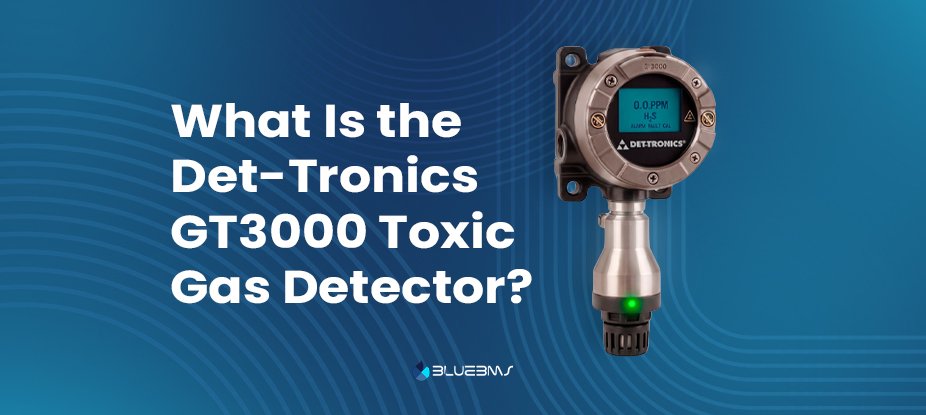
The Det-Tronics GT3000 toxic gas detector is an electrochemical, fixed-point instrument for toxic gas and oxygen-depletion monitoring. It pairs a factory-calibrated sensor module (GTS) with a transmitter (GTX) to continuously monitor for H2S, CO, O2, NH3, Cl2, SO2, NO2, or H2, outputting 4-20 mA with HART for integration into any fire and gas safety system. This GT3000 toxic gas detector is specified anywhere personnel — not just equipment — face gas exposure risk: wellheads, compressor buildings, confined spaces, and process areas across oil and gas, petrochemical, and LNG facilities.
What the GT3000 Toxic Gas Detector Is For
Most gas detection conversations start with flammability — the fear of an explosion. The GT3000 addresses a different, quieter risk: toxicity. Hydrogen sulfide, carbon monoxide, chlorine, ammonia — these gases don’t need to reach a flammable concentration to kill or injure someone. A few hundred parts per million of H2S can be fatal in minutes, well below any explosive threshold. The GT3000 exists to catch that exposure before it reaches personnel, not just before it reaches an ignition source.
This distinction matters for how the detector gets specified. While flame detectors and combustible gas detectors protect assets and processes, the GT3000 is typically driven by a personnel-safety case: confined space entry procedures, permit-to-work systems, and occupational exposure limits set by standards like OSHA PEL or ACGIH TLV. It shows up on the same P&IDs as the rest of a Det-Tronics fire and gas architecture, but the hazard analysis behind it usually starts with a toxicology data sheet, not a flash point.
How the GT3000 Toxic Gas Detector Works
The GT3000 is built as a two-part, modular system:
- GTX transmitter — the fixed, field-wired body. It houses the electronics, generates the 4-20 mA/HART output, and stays in place through the life of the installation.
- GTS sensor module — an electrochemical cell factory-calibrated to one specific gas and concentration range. It plugs into the transmitter and can be swapped in the field.
The electrochemical cell uses capillary diffusion barrier technology: gas diffuses through a controlled barrier into the cell, where it reacts to produce a current proportional to concentration. Because the sensor is factory-calibrated to a specific gas and range rather than a generic combustible-gas response, accuracy and cross-sensitivity are tighter than what you get from a general-purpose sensor retrofitted to a new application.
The output is a 4-20 mA signal with HART, corresponding directly to 0-100% of the sensor’s full-scale range. Response is fast — third-party testing to the ISA-92.0.01 standard shows the GT3000 exceeding the T90 requirement in under 30 seconds, with typical T50 response around 10-15 seconds depending on the target gas.
Gases Detected
The GT3000 family currently covers eight gas types, each via its own dedicated, factory-calibrated GTS sensor module available in specific concentration ranges:
| Gas | Formula | Available Ranges | Typical Concern | SIL 2 |
|---|---|---|---|---|
| Hydrogen Sulfide | H2S | 0-20 / 0-50 / 0-100 ppm | Wellheads, produced water, sour gas processing | Yes |
| Oxygen (depletion) | O2 | 1-25% by volume | Confined spaces, purged/inerted vessels | Yes |
| Carbon Monoxide | CO | 0-100 / 0-500 ppm | Enclosed combustion spaces, compressor buildings | No |
| Hydrogen | H2 | 0-1,000 ppm | Battery rooms, electrolysis, HVDC converter stations | No |
| Ammonia | NH3 | 0-100 / 0-500 ppm | Refrigeration systems, fertilizer plants | No |
| Chlorine | Cl2 | 0-10 ppm | Water and wastewater treatment | No |
| Sulfur Dioxide | SO2 | 0-20 / 0-100 ppm | Combustion processes, sulfur recovery units | No |
| Nitrogen Dioxide | NO2 | 0-20 ppm | Combustion exhaust, diesel generator enclosures | No |
H2S and O2 sensor modules are certified SIL 2 capable — relevant wherever the gas detection loop is being counted as a layer of protection in a formal SIL assessment (see our guide to SIL 2 in fire and gas systems).
Response time and accuracy are not uniform across the family — each gas/range combination has its own certified performance, since the ISA-92.0.01 T90 requirement is verified per sensor type, not as a blanket spec for the product line:
| Gas / Range | Response (T50 / T90) | Op. Temperature | Accuracy |
|---|---|---|---|
| H2S, 0-20/0-50 ppm | T50 ≤13s / T90 ≤30s | -40°C to +55°C | ±2 ppm or ±10% of reading |
| H2S, 0-100 ppm | T50 ≤13s / T90 ≤30s | -40°C to +55°C | ±2 ppm or ±10% of reading |
| O2, 1-25% vol | T20 = 7s / T90 = 30s | -20°C to +50°C | <0.5% by volume |
| CO, 0-100/0-500 ppm | T50 = 15s / T90 = 40s | -20°C to +50°C | ±5 ppm or ±10% of reading |
| NH3, 0-100 ppm | T50 = 24s / T90 = 65s | -20°C to +40°C | ±4 ppm or ±15% of reading |
| NH3, 0-500 ppm | T50 = 30s / T90 = 120s | -20°C to +40°C | ±4 ppm or ±15% of reading |
| SO2, 0-20/0-100 ppm | T50 = 12-15s / T90 = 30-35s | -40°C to +55°C | ±0.6 ppm or ±15% of reading |
| Cl2, 0-10 ppm | T50 ≤14s / T90 ≤34s | -20°C to +50°C | ±0.6 ppm or ±30% of reading |
| H2, 0-1,000 ppm | T50 = 8s / T90 = 60s | -20°C to +40°C | ±50 ppm or ±10% of reading |
| NO2, 0-20 ppm | T50 = 7s / T90 = 31s | -20°C to +40°C | ±2 ppm or ±10% of reading |
Source: Det-Tronics GT3000 Instructions Manual, form 95-7616, Rev. 12.9 (07/2024) — figures apply to standard sensor variants and can differ slightly by approval/model code.
Technical Specifications
These are the full specifications for the GT3000 toxic gas detector, covering electrical, environmental, and certification data for both the GTX transmitter and GTS sensor modules:
| Parameter | Specification |
|---|---|
| Sensor technology | Electrochemical cell, capillary diffusion barrier |
| Output signal | 4-20 mA with HART, 0-100% full-scale linear (3.8 mA = calibrating; 17.3 mA on O2 during calibration) |
| Power | Two-wire, loop-powered; 24 Vdc nominal (12-30 Vdc range); max 0.8 W at 30 Vdc |
| Max loop resistance | 300 Ω at 18 Vdc / 600 Ω at 24 Vdc |
| Fault output | 3.5 mA or 2.45 mA (selectable via GTX output code) |
| Response time | Varies by gas — see table above; exceeds ISA-92.0.01 T90 requirement (3rd-party verified) |
| Warm-up time | Up to 150 seconds |
| Operating temperature | Varies by gas/sensor, -40°C to +55°C across the family — see table above |
| Storage temperature | Transmitter: -55°C to +75°C; Sensor: 0°C to +20°C (ideal +4°C to +10°C) |
| Operating humidity | 15-90% RH |
| Enclosure | GTX: 316 stainless steel; GTS housing: PPA, 30% carbon-filled — IP66 |
| Thread options | 3/4″ NPT or M25 |
| Cabling | 20″ flying leads, 600V insulation, 22 AWG (red/black) + 16 AWG (green ground) |
| Max remote cable length | 610 m (2,000 ft) between GT3000 and a FlexVu UD10/UD20/UD30 display |
| Area classification | Ex-proof: Class I, Div. 1/2, Groups A-D (T4); Zone 1, AEx d mb [ia Ga] IIC T4 Gb. IS: Class I, Div. 1, Groups A-D (T4); Zone 0, AEx ia IIC T4 Ga |
| Certifications | FM, CSA, IECEx, INMETRO (Brazil), DNV Type Approval; SIL 2 capable (H2S, O2 only, per IEC 61508) |
| Diagnostics | Onboard event log (256 records), gas exposure history, calibration data, temperature history, real-time clock — via HART, UD10/UD20, or AMS software |
| Expected service life | 2 years in outdoor environment |
| Storage shelf life | 6 months in factory-sealed packaging |
| Warranty | 12 months from energization or 18 months from shipment, whichever comes first |
| Language variants | English, Portuguese (Brazil), Russian, Chinese, Kazakh label options |
| Availability | Not available for sale in the EU or UK |
Standout Features
Hot-swappable, intrinsically safe sensor modules
Because the GTS sensor module is intrinsically safe, it can be swapped in the field without declassifying the hazardous area first — no hot-work permit, no gas-freeing the area, no shutting down adjacent operations. This is one of the more meaningful maintenance-cost differences between the GT3000 and older toxic gas detector families that require the whole transmitter to be pulled for sensor replacement.
Tool-free hydrophobic filter replacement
The hydrophobic filter — which protects the sensor cell from moisture and dust while remaining gas-permeable — can be replaced without opening the enclosure or using tools. In humid or dusty environments (offshore platforms, wastewater plants), this is a routine maintenance task rather than a scheduled outage.
Stand-alone or networked
The GT3000 works as a fully stand-alone loop-powered device with local calibration via a magnetic switch and onboard LEDs — no display required. It’s also compatible with the FlexVu® UD10/UD20/UD30 Universal Display for local digital readout, and can report into an Eagle Quantum Premier® (EQP) addressable fire and gas controller alongside PIRECL, LS2000, and X3301 devices on a shared Local Operating Network (LON) — replacing point-to-point home-run wiring on larger sites.
Where the GT3000 Toxic Gas Detector Is Specified
The GT3000’s use cases track directly to where toxic gas exposure — not just flammability — is the driving hazard:
- Oil & gas production — H2S monitoring around wellheads, separators, and produced-water handling on sour gas fields, both onshore and offshore.
- LNG facilities — combined with combustible gas detection for a complete hazard picture at liquefaction and regasification terminals (see our gas detection requirements for LNG terminals).
- Petrochemical and refining — H2S and SO2 in sulfur recovery units; CO around fired heaters and enclosed process areas.
- Power generation and mechanical drives — CO and NO2 in turbine enclosures, generator rooms, and diesel-genset spaces; H2 in battery rooms.
- HVDC converter stations — hydrogen monitoring where large battery banks or electrolysis processes are present.
- Wastewater treatment — H2S and Cl2 monitoring at lift stations, digesters, and chlorine storage/dosing areas.
- Confined spaces — O2 depletion monitoring ahead of permit-required entry, on vessels, tanks, and enclosed process equipment.
- Duct-mounted applications — GT3000 sensors installed in HVAC intake ductwork to stop toxic gas ingress before it reaches occupied or control spaces.
For flame detection in the same hazardous areas, Blue BMS also supplies the complementary Det-Tronics X3301 multispectrum IR flame detector, and for combustible hydrocarbon gas, the PIRECL PointWatch Eclipse. Together with the GT3000, these three devices — plus the LS2000 open-path detector — form the field-device layer of a typical Det-Tronics fire and gas architecture, reporting into an EQP controller.
Calibration and Maintenance in Practice
The GT3000 supports one-person calibration, started either locally with a magnetic calibration pen or remotely through a HART command — no tools required to remove the replaceable filter or trigger the sequence. A few practical details matter for anyone planning the maintenance program:
Spec Note
GT3000 vs. Older Catalytic and Toxic Gas Sensors
Specifiers replacing legacy toxic gas detectors with the GT3000 toxic gas detector (including Det-Tronics’ own older C706x series) make the switch for three practical reasons:
| Consideration | GT3000 (electrochemical, modular) | Legacy fixed-sensor units |
|---|---|---|
| Sensor replacement | Hot-swappable GTS module, no declassification | Often requires full transmitter removal or area gas-freeing |
| Calibration | Factory-calibrated per gas/range, local calibration supported | Frequently requires field calibration against reference gas at every service |
| Diagnostics | Onboard event log, exposure history, HART diagnostics | Limited or no historical data logging |
| Integration | Stand-alone, FlexVu display, or native EQP network | Typically point-to-point only |
Spec-Stage Considerations
A few decisions are cheaper to make before the GT3000 goes on the BOM than after commissioning:
Spec Note
Frequently Asked Questions
What does the Det-Tronics GT3000 toxic gas detector detect?
The GT3000 toxic gas detector detects toxic gases and oxygen depletion. Depending on the sensor module (GTS) installed, it covers hydrogen sulfide (H2S), oxygen (O2), carbon monoxide (CO), hydrogen (H2), ammonia (NH3), chlorine (Cl2), sulfur dioxide (SO2), and nitrogen dioxide (NO2).
Is the GT3000 the same as a combustible gas detector?
No. The GT3000 is an electrochemical toxic gas and oxygen-depletion detector, aimed at personnel exposure risk. For combustible hydrocarbon gas detection, Det-Tronics’ point-type solution is the PIRECL PointWatch Eclipse, and its open-path solution is the LS2000 FlexSight.
Can the GT3000 sensor be replaced without shutting down the area?
Yes. The GTS sensor module is intrinsically safe and hot-swappable, meaning it can be replaced in the field without declassifying the hazardous area first.
Does the GT3000 require a separate display unit?
No. It’s approved as a stand-alone unit with local calibration via a magnetic switch and onboard LEDs. A FlexVu® UD10/UD20/UD30 display or an Eagle Quantum Premier® (EQP) controller can be added for local readout or network integration, but neither is mandatory.
Is the GT3000 SIL 2 capable?
The H2S and O2 sensor modules are certified SIL 2 capable, which matters for facilities running a formal safety instrumented function assessment under IEC 61508/61511.
Is the GT3000 available in Europe?
No. The GT3000 Toxic Gas Detector is not currently available for sale in the European Union or the United Kingdom.
How often does the GT3000 need to be calibrated?
Every GT3000 sensor requires a two-point (zero and span) calibration. Typical intervals are every 30, 60, or 90 days depending on ambient conditions and gas exposure history at the specific site.
Can the GT3000 sensor be calibrated without shutting the loop down?
Calibration is a one-person process started locally with a magnetic pen or remotely via HART. The GTX transmitter outputs a dedicated 3.8 mA calibration signal (17.3 mA for O2 sensors) during the process, so downstream logic can recognize and inhibit response devices without a full loop shutdown.
Talk to Blue BMS About the GT3000
Blue BMS distributes the full Det-Tronics GT3000 line, including GTX transmitters, GTS sensor modules for all eight gas types, calibration kits, and FlexVu displays. If you’re specifying toxic gas detection for a wellhead, process unit, or confined-space application, get in touch with our team for datasheets, lead times, and configuration support.