Det-Tronics: Global Fire and Gas Detection Solutions Across Every Industry
When a gas leak or a flash fire can shut down a platform, a refinery, or a production line in seconds, the detection system in place is not a formality — it is the difference between a controlled response and a catastrophe. Few names carry as much weight in that conversation as Det-Tronics. For more than 50 years, its flame and gas detection technology has protected people, assets, and operations in some of the most demanding environments on the planet.
In this article, we introduce Det-Tronics as a brand, break down its product portfolio, look at the industries it protects — with a close-up on oil and gas — and explain how Blue BMS brings these Det-Tronics fire and gas detection solutions to clients across every vertical we serve.
Det-Tronics at a Glance
- ● Founded in 1973 — 50+ years protecting critical operations
- ● Headquartered in Minneapolis, Minnesota, USA
- ● SIL 2-capable flame, gas, and hazard mitigation systems
- ● Part of Spectrum Safety Solutions (since 2024)
- ● Sales & service offices on every continent
- ● 200+ offshore platforms protected worldwide
Who Is Det-Tronics?
Det-Tronics — formally Detector Electronics Corporation — was founded in 1973 and has spent five decades designing, manufacturing, and commissioning fire and gas safety systems for high-risk, mission-critical operations. The company’s headquarters and testing facilities remain in Minneapolis, Minnesota, where its flame and gas detectors go through some of the most rigorous fire, fuel-type, and false-alarm testing in the industry. You can read more about the company directly on the official Det-Tronics about page.
Ownership has shifted in recent years, and it’s worth being precise about where things stand today: Det-Tronics is part of Spectrum Safety Solutions, a platform created in 2024 when Sentinel Capital Partners acquired the industrial fire and gas detection business from Carrier Global Corporation. In short — same engineering team and testing standards, new ownership structure.
Product Portfolio: What Det-Tronics Actually Builds
Det-Tronics’ catalog centers on three connected categories: flame detection, gas detection, and the controllers and displays that tie a site’s safety system together.
Flame Detectors
- Optical technologies spanning UV, IR, UV/IR, Dual IR, and Multispectrum IR, engineered to maximize detection speed while minimizing false alarms.
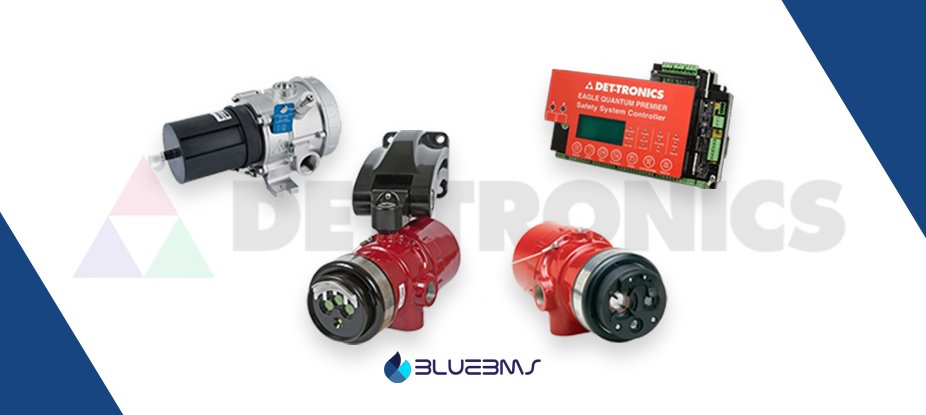
- X3301 Multispectrum Infrared Flame Detector — an explosion-proof, SIL 2-rated detector with model variants optimized for aircraft hangars, turbine enclosures, and automotive paint spray booths.
Gas Detectors
- Combustible gas detection using catalytic bead and point infrared technology, including the PointWatch Eclipse infrared hydrocarbon gas detector, certified to detect methane, propane, ethylene, and butane.
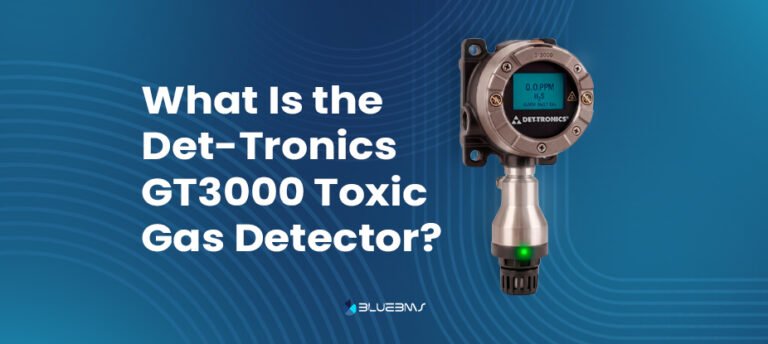
- Toxic gas detection with the GT3000 electrochemical detector, covering hydrogen sulfide, hydrogen, oxygen, carbon monoxide, nitrogen dioxide, ammonia, chlorine, and sulfur dioxide, with hot-swappable intrinsically safe sensors.
- Open-path and line-of-sight detection such as the FlexSight LS2000, monitoring combustible gas clouds across distances beyond 100 meters — built for everything from foggy North Sea platforms to Arctic pipelines.
- Acoustic gas leak detection with the FlexSonic, which listens for the high-frequency sound of a pressurized gas leak the instant it happens rather than waiting for gas to reach a sensor — an exida safety award winner.
- Explosion-proof smoke detectors for hazardous industrial and commercial locations.
Controllers and Displays
- Eagle Quantum Premier (EQP) — an addressable-loop, fault-tolerant Fire and Gas Safety Controller compliant with NFPA 72, capable of integrating both Det-Tronics and third-party devices into one safety architecture.
- FlexVu Universal Display Family — display, output, and control capability with non-intrusive, one-person calibration and diagnostics.
Certifications & Compliance
SIL 2
Functional safety rating
ATEX / IECEx
Explosive atmosphere approval
FM
Factory Mutual approval
NFPA 72
Fire alarm code compliance
DNV / MED
Marine & offshore approval
INMETRO
Brazil hazardous location cert
Global local approvals
Hundreds of national and regional certifications
These certifications aren’t paperwork for its own sake — they’re what lets a detector cross borders. A system certified for IECEx and ATEX explosive-atmosphere zones in Europe and the Middle East, FM-approved for North America, and INMETRO-certified for Brazil can move across a global project’s regions without a redesign at every border — which is exactly the kind of cross-border specification work Blue BMS handles daily.
Industries Det-Tronics Protects
Oil & Gas
Petrochemical & Chemical
Marine & Offshore
Aerospace & Hangars
Automotive (Paint Booths)
Munitions & Defense
Storage Tanks
Wastewater Treatment
HVDC Converter Stations
Power Generation
Critical Infrastructure & Pipeline Compressor Stations
Industries Served — Built for High-Hazard Environments
Det-Tronics engineers for the environments where standard detection equipment falls short: extreme temperatures, remote unstaffed sites, corrosive atmospheres, and locations where a false alarm is nearly as costly as a missed one. That versatility is why its systems show up across such a wide industrial map — oil and gas, petrochemical and chemical processing, marine and offshore, aerospace, automotive, munitions and defense, power generation, storage tanks, wastewater treatment, and HVDC converter stations.
Each of these sectors uses the same underlying philosophy — fast, reliable detection with minimal false alarms — applied to very different risk profiles. An aircraft hangar needs flame detectors tuned to jet fuel fires and tolerant of hangar-door movement and lighting changes. An automotive paint booth needs detectors that ignore solvent vapor without missing an actual ignition. A munitions facility needs systems certified for explosive atmospheres. Det-Tronics builds detector variants and certifications for each of these realities rather than offering one generic product across the board.
Oil & Gas: Where Det-Tronics Has Built Its Deepest Track Record
If there’s one sector that defines the Det-Tronics story, it’s oil and gas — and it’s easy to see why. Across upstream, midstream, and downstream operations, the stakes are the same: high-value assets, flammable materials, and environments that are frequently offshore, remote, or unstaffed. It’s also the sector where Blue BMS spends the most time — see our dedicated Oil & Gas vertical solutions page for the full picture beyond detection alone.
Det-Tronics systems today protect more than 200 offshore drilling platforms, with installations spanning the North Sea, South America, and Southeast Asia — regions chosen not for convenience but because they represent some of the harshest, most logistically complex environments in the energy sector. On these platforms, gas detectors are engineered to keep monitoring reliably in salt spray, high winds, and constant vibration, while flame detectors need to separate a genuine hydrocarbon fire from sun glare, welding sparks, or lightning.
The same technology extends across the full value chain:
- Upstream — offshore and onshore drilling platforms, wellheads, and production facilities.
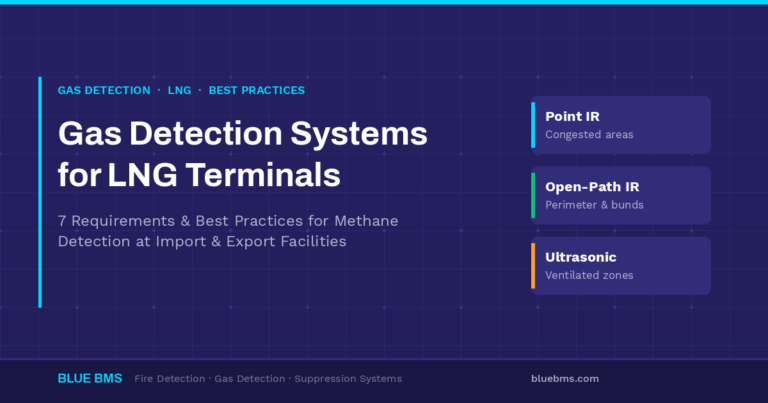
- Midstream — pipeline compressor stations and LNG terminals, where flame and gas detection protects operational continuity as global demand for natural gas keeps rising.
- Downstream — refineries and petrochemical complexes, where dense equipment layouts and continuous processes leave little room for detection blind spots.
Det-Tronics doesn’t disclose the fine detail of individual client installations — understandably, given the sensitivity of critical infrastructure security — but its own public track record is telling on its own: hundreds of platforms, terminals, and processing sites across five continents relying on the same certified detection philosophy for decades, with recent expansion into optical gas detection for energy and marine applications through the Optronics acquisition.
Beyond Oil & Gas: The Same Reliability, Different Risk Profiles
The oil and gas track record is the headline, but it’s worth being clear that Det-Tronics’ relevance doesn’t stop there — and this is exactly where a distributor like Blue BMS becomes valuable for other sectors too:
- Petrochemical & Chemical: dense processing environments where the same SIL 2 flame and gas philosophy protects against both fire and toxic gas exposure.
- Marine & Offshore: vessels and floating platforms where corrosion resistance and certification for confined, hazardous spaces are non-negotiable.
- Aerospace: aircraft hangars and turbine enclosures, protecting high-value assets with detectors tuned to aviation fuel fire signatures.
- Automotive: paint spray booths, where detectors are calibrated to avoid false alarms from solvent vapors while still catching genuine ignition.
- Munitions & Defense: facilities requiring certification for explosive atmospheres and high-consequence failure modes.
- Storage Tanks: floating-roof and fixed-roof tank farms, where flammable vapor accumulation demands continuous, low-maintenance monitoring.
- Wastewater Treatment: facilities handling methane and hydrogen sulfide byproducts, where toxic gas detection protects both staff and equipment.
- HVDC Converter Stations: high-voltage direct current infrastructure, an increasingly important application as grid interconnection projects expand worldwide.
- Power Generation: turbine halls and fuel-handling areas where continuous, unattended monitoring is essential — part of the broader scope covered on our Energy & Fire Safety solutions page.
Det-Tronics Products You’ll Find on the Blue BMS Catalog
This isn’t a brand we’re introducing from the outside — Det-Tronics is already one of the core manufacturers in the Blue BMS catalog, and a few of its models come up in specification conversations more than any others. Here’s a closer look at some of them, and where each one typically earns its place in a fire and gas system:
- X3301 Multispectrum Infrared Flame Detector — the flagship flame detector in the range, and the one we quote most often for oil & gas, offshore, and petrochemical projects. It reads a flame’s radiation spectrum across multiple IR wavelengths to confirm a real hydrocarbon fire in seconds, while filtering out welding sparks, sunlight, and hot surfaces — the false-alarm sources that make open, high-traffic industrial sites hard to protect.
- X5200 UV/IR Flame Detector — a step below the X3301 in coverage range but a strong fit where budget or application calls for combined UV/IR sensing rather than full multispectrum detection, still built for harsh outdoor and indoor conditions.
- PointWatch Eclipse (PIRECL) Infrared Hydrocarbon Gas Detector — SIL 2-certified with a fast 1-second response and marine/offshore certifications (DNV, MED), making it one of our go-to gas detectors for vessels and offshore platforms as much as onshore facilities.
- PointWatch PIR9400 — a fixed-point infrared detector for continuous monitoring of combustible hydrocarbon gases, commonly specified where a simpler point-detection layout fits the site better than open-path coverage.
- GT3000 Series Toxic Gas Transmitter — the electrochemical side of the portfolio, covering gases like H2S and CO with hot-swappable sensors, which matters a great deal on sites where a transmitter can’t be taken fully offline for maintenance.
You can browse the complete, regularly updated line on our Det-Tronics brand page. If you’re weighing options across brands, our Autronica brand page covers a similarly SIL 2-rated range worth comparing against.
How to Choose the Right Detector
With this many models, the question we hear most often isn’t “which brand” — it’s “which one, for this specific spot.” A simplified way to narrow it down:
- Open, high-traffic area with sun glare or welding nearby? Lean toward the X3301 — multispectrum IR filters out the false-alarm sources single-band detectors struggle with.
- Confined indoor space or tighter budget? The X5200’s UV/IR combination is often enough without the multispectrum premium.
- Marine, offshore, or corrosive outdoor environment? Prioritize DNV/MED-certified gas detection — the PointWatch Eclipse (PIRECL) is built for exactly that.
- Simple point coverage indoors? The PIR9400 usually covers it without needing open-path equipment.
- Toxic gas exposure risk (H2S, CO) where downtime for maintenance isn’t an option? The GT3000’s hot-swappable sensors are the deciding factor.
This is a starting point, not a substitute for a proper site assessment — area classification, gas type, wind exposure, and existing controller architecture all factor in. That’s the conversation our team has with you before any quote goes out.
How Blue BMS Brings These Solutions to Your Project
Carrying the products is only half the job. As a global B2B distributor spanning fire detection, gas detection, fire suppression, electronic security, and building management systems, Blue BMS’s role with Det-Tronics is to translate a site’s risk profile into the right detector configuration — matching flame detector type to fuel and false-alarm sources, gas detector technology to the target gas and site layout, and certifications to the region and application — then get it there fast, with local support through our hub in Portugal and our teams across the regions we serve.
That combination — a manufacturer with five decades of field-proven engineering, paired with a distributor that knows how to spec and deliver it for your exact site — is what we mean when we talk about Blue BMS and Det-Tronics together. If oil and gas is your priority, as it is for a large share of our client base, this is usually the strongest starting point for a fire and gas detection specification. But the same catalog, and the same support, is there just as readily if you’re protecting a hangar, a processing plant, or a power station.
Frequently Asked Questions
What is Det-Tronics known for?
Det-Tronics is a global manufacturer of flame detection, gas detection, and hazard mitigation systems, founded in 1973 and headquartered in Minneapolis, Minnesota. It is best known for SIL 2-capable detection technology, including the Eagle Quantum Premier fire and gas safety controller and the X3301 Multispectrum Infrared flame detector.
Which industries does Det-Tronics serve?
Det-Tronics serves oil and gas (upstream, midstream, downstream), petrochemical and chemical processing, marine and offshore, aerospace and aircraft hangars, automotive paint booths, munitions and defense, power generation, storage tanks, wastewater treatment, and HVDC converter stations, among other high-hazard industrial sectors.
Why is Det-Tronics important for the oil and gas industry?
Det-Tronics fire and gas systems are engineered for extreme, often remote and unstaffed environments typical of oil and gas operations. Its detectors protect offshore platforms, LNG terminals, refineries, and pipeline compressor stations, with more than 200 platforms worldwide relying on its technology.
Who owns Det-Tronics today?
Det-Tronics is part of Spectrum Safety Solutions, a platform created in 2024 when Sentinel Capital Partners acquired the industrial fire and gas detection business from Carrier Global Corporation. Spectrum Safety Solutions is headquartered in Stamford, Connecticut, and also owns the Fireye brand.
How does Blue BMS work with Det-Tronics?
Blue BMS distributes and supports Det-Tronics fire and gas detection systems as part of its global B2B portfolio, helping clients across oil and gas, industrial, and commercial sectors specify, source, and deploy certified detection and hazard mitigation solutions worldwide.
Ready to specify Det-Tronics for your next project?
Talk to the Blue BMS team about product availability, lead times, and technical support in your region.