This guide covers everything facility managers, safety engineers, and procurement teams need to know: how these systems work, which detector types apply to each industrial scenario, the standards that govern them, and how to build an integrated fire safety strategy across oil & gas, offshore, data center, and manufacturing environments.
What Is an Industrial Fire Detection System?
An industrial fire detection system is an integrated network of sensors, control panels, alarm devices, and communication interfaces designed to detect fire, smoke, flame, or hazardous gas in industrial environments. Unlike standard commercial systems, industrial solutions must operate reliably in the presence of dust, moisture, vibration, electromagnetic interference, and potentially explosive atmospheres — and must comply with sector-specific standards such as NFPA 72, IEC 61508, and ATEX/IECEx directives.
Key components typically include: flame detectors, smoke detectors, heat detectors, gas detectors, fire alarm control panels (FACPs), manual call points, sounders/strobes, and integration interfaces for BMS, SCADA, and suppression systems.
Why Industrial Fire Detection Is Different
A standard smoke detector installed in a warehouse ceiling may never detect a fire in time. Industrial environments present conditions that defeat conventional detection technology at nearly every level:
- High ceilings and open spaces: Smoke disperses before reaching ceiling-mounted point detectors. Optical beam detectors or aspirating systems are required.
- Explosive atmospheres (Zone 0/1/2): Any electrical component must carry ATEX or IECEx certification to avoid becoming the ignition source itself.
- False alarm environments: Dust, steam, welding fumes, and exhaust gases can trigger conventional detectors constantly — leading operators to disable them, eliminating protection entirely.
- Continuous operations: Refineries, offshore platforms, and data centers cannot shut down for false alarms. Detection systems must achieve near-zero false alarm rates.
- Response time criticality: In oil & gas environments, a 30-second delay in flame detection can escalate a minor flare to a catastrophic blowout. Detection must be measured in seconds, not minutes.
- Environmental extremes: Operating temperatures from −40°C to +85°C, IP66/IP67 ingress protection, corrosion-resistant enclosures, and vibration tolerance are standard requirements offshore.
These challenges make industrial fire detection a specialized engineering discipline — not a product selection exercise.
How Industrial Fire Detection Systems Work
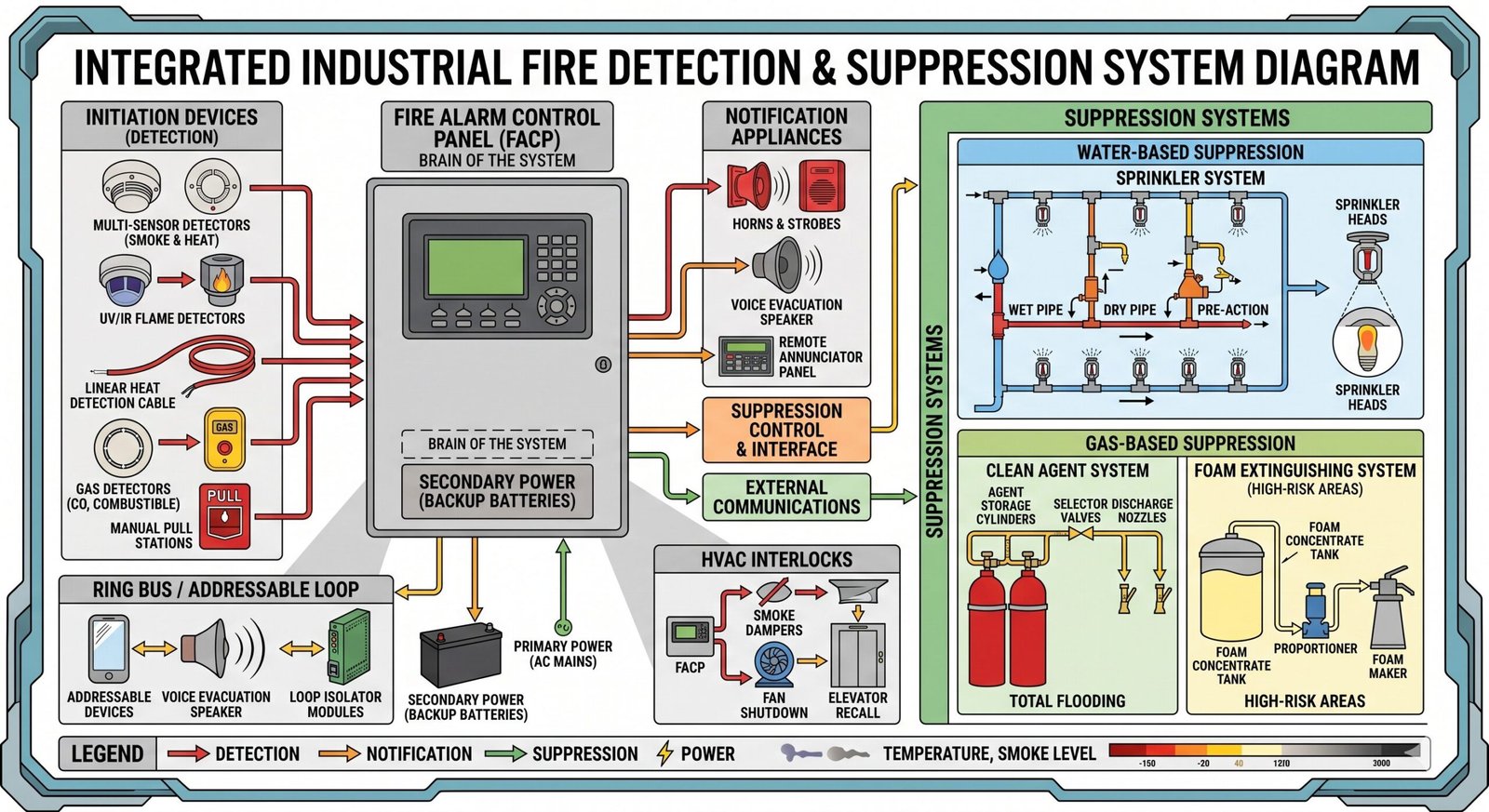
At its core, an industrial fire detection system converts physical phenomena – light radiation, combustion gases, heat, particles – into electrical signals, processes those signals through intelligent control panels, and triggers appropriate responses: alarms, suppression activation, SCADA notifications, or facility shutdowns.
For a detailed breakdown of the detection-to-response chain, see our complete guide: How Fire Detection Systems Work: Understanding Their Functionality and Types.
The basic operational loop in an industrial system involves four stages:
- Detection: One or more sensor types identify a fire signature (flame radiation, smoke particles, thermal rise, or combustible gas concentration).
- Processing: The fire alarm control panel (FACP) applies voting logic, cross-zoning, or AI-based algorithms to validate the alarm and filter false positives.
- Annunciation: Audible and visual alarms activate. Signals are transmitted to control rooms, BMS, SCADA, and where required – emergency services.
- Response: Pre-programmed actions execute: suppression system activation, ventilation shutdown, equipment isolation, emergency lighting, and evacuation sequences.
Modern industrial systems increasingly incorporate SIL-rated (Safety Integrity Level) logic to ensure that safety functions perform correctly even under fault conditions a critical requirement in oil & gas and chemical processing under IEC 61508 and IEC 61511.
 Industrial fire detection process diagram
Types of Industrial Fire Detectors
No single detector type covers every industrial scenario. Effective fire safety architecture combines multiple detection technologies, each selected for the specific hazards, environmental conditions, and response time requirements of each zone.
1. Flame Detectors
Flame detectors are the primary choice for outdoor industrial areas, open process facilities, turbine halls, hangars, and any location where smoke-based detection is impractical. They detect the electromagnetic radiation emitted by a flame – operating in the ultraviolet (UV), infrared (IR), or combined UV/IR spectrum.
- UV detectors respond in milliseconds to the UV radiation of hydrocarbon and hydrogen fires. Highly sensitive but susceptible to false alarms from arc welding, lightning, and sunlight.
- Single-IR detectors monitor a specific IR wavelength associated with CO₂ pulsation in a flame. Good for hydrocarbon fires but may false alarm from hot objects or solar radiation.
- UV/IR combination detectors require simultaneous UV and IR signals, dramatically reducing false alarms while maintaining fast response. Ideal for harsh industrial environments.
- Multi-spectrum IR (Triple IR) detectors compare three specific infrared bands to identify the unique signature of a hydrocarbon flame. Extremely resistant to false alarms — the preferred technology for offshore, refineries, and areas with heavy background radiation.
For a direct technology comparison, read: UV/IR and Multi IR Flame Detectors: What’s the Difference and Where Are They Most Effective?
One of the most advanced flame detectors currently available for industrial use is the Det-Tronics X3301 Multispectrum IR Flame Detector, which uses proprietary multispectrum analysis to detect fires at distances up to 65 meters with near-zero false alarm rate — even in environments with solar loading, hot work, or steam backgrounds.
2. Smoke Detectors
Smoke detection in industrial settings requires solutions that overcome the false alarm challenges of conventional ionization or photoelectric point detectors.
- Optical beam smoke detectors project an infrared beam across large spaces (up to 100–150 m). Smoke entering the beam attenuates the signal, triggering the alarm. Ideal for warehouses, atriums, conveyors, and large open industrial spaces. See our guide on Fireray Beam Detectors for installation and sensitivity configuration.
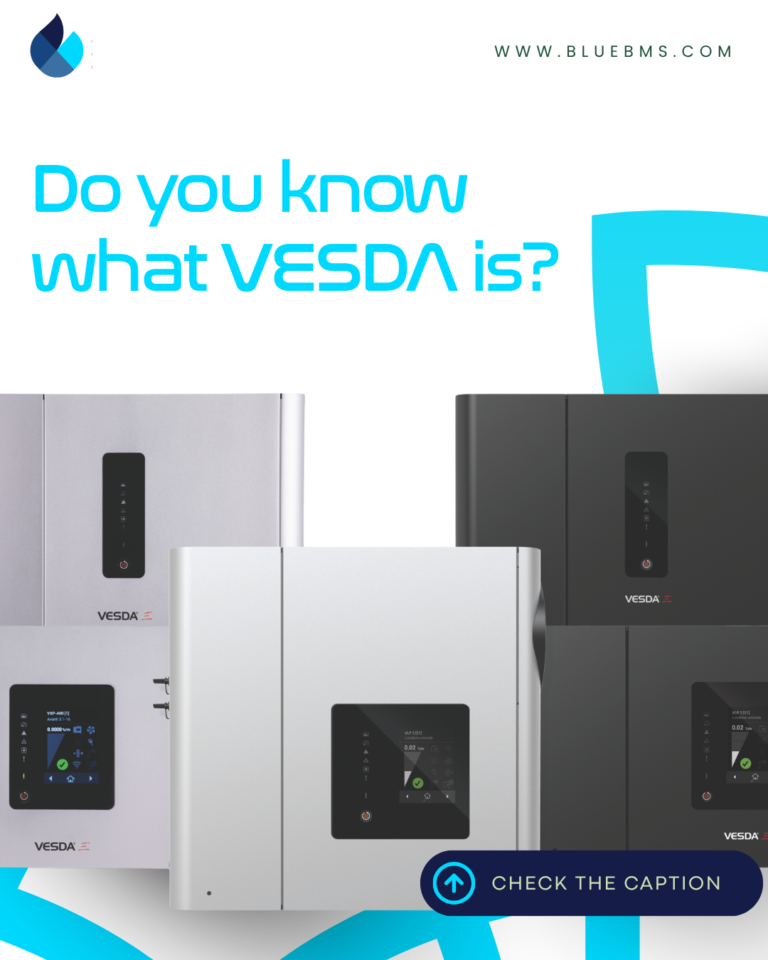
- Aspirating Smoke Detection (ASD / VESDA): Pipes with sample holes draw air continuously to a highly sensitive detection chamber. ASD systems can detect smoke at concentrations 100× lower than conventional detectors – critical for data centers, clean rooms, and telecom facilities where early warning is essential for protecting irreplaceable equipment.
- Point smoke detectors remain valid for enclosed rooms, cable ducts, and control rooms where ceiling heights are manageable and environmental conditions are controlled.
3. Gas Detectors
In facilities handling flammable, toxic, or asphyxiant gases, combustion detection alone is insufficient. Gas detection provides the first line of warning — detecting dangerous concentrations before ignition is possible.
Industrial gas detectors measure concentrations of:
- Flammable gases (methane, propane, hydrogen) — typically as a percentage of LEL (Lower Explosive Limit)
- Toxic gases (H₂S, CO, ammonia, chlorine) — in parts per million (ppm)
- Oxygen depletion or enrichment
- Refrigerant gases (critical for HVAC systems in data centers)
Gas detection technologies include catalytic bead (pellistor) sensors, electrochemical cells, infrared (IR) sensors, and photoionization detectors (PID). For duct-mounted applications — monitoring combustion gases within HVAC infrastructure — the DuctWatch IR Gas Detector (PIRDUCT) provides continuous, maintenance-friendly monitoring without disrupting airflow. For a comprehensive overview of industrial gas leak scenarios and system design, see: Gas Leak Detection Systems.
4. Heat Detectors
Heat detectors respond to temperature rise rather than combustion byproducts. They are particularly suited for environments where smoke or gas detectors would produce excessive false alarms: kitchens, boiler rooms, battery storage, and areas with heavy dust or fumes.
- Fixed temperature detectors trigger when ambient temperature exceeds a preset threshold (typically 57°C–78°C for standard applications; up to 138°C for high-temperature environments).
- Rate-of-rise detectors alarm when temperature increases faster than a defined rate (e.g., 8°C per minute), regardless of absolute temperature — detecting fast-developing fires before fixed-temperature units respond.
- Linear heat detection cables run along cable trays, conveyor belts, and tunnel infrastructure — providing zone-specific thermal monitoring across distances of hundreds of meters.
Key Components & Control Panels
The intelligence of an industrial fire detection system resides in its control infrastructure — the hardware and software that processes sensor signals, validates alarms, manages voting logic, and orchestrates system-wide responses.

Fire Alarm Control Panels (FACP)
Industrial FACPs range from conventional zone panels for smaller facilities to fully addressable, networked systems capable of monitoring thousands of devices across multiple buildings or platforms. Addressable systems assign a unique address to every detector, providing precise location data for each alarm event — critical for rapid response in large or complex industrial sites.
For high-criticality applications — particularly in oil & gas, petrochemical, and offshore — SIL 2-rated controllers provide verified functional safety performance. The Eagle Quantum Premier (EQP) from Det-Tronics is one such controller: a digital fire & gas control system certified to SIL 2, supporting integration with flame detectors, gas detectors, and suppression interfaces in a single architecture.
System Wiring & Network Architecture
Industrial fire detection wiring must account for cable routing in hazardous areas, EMI shielding, redundant communication loops, and fault-tolerant topologies. Understanding the wiring diagram is essential for system commissioning, maintenance, and troubleshooting. Our detailed reference — Definitive Guide to Decoding the Fire Alarm System Wiring Diagram — covers conventional and addressable wiring in depth.
Integration Relays & Output Modules
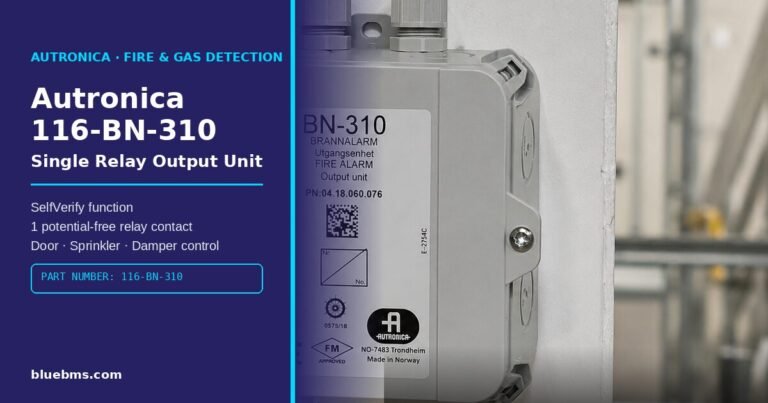
Industrial fire systems rarely operate in isolation. Output modules and integration relays — such as the MR101 Relay — enable fire detection panels to trigger actions in third-party systems: suppression activation, BMS commands, SCADA alarms, access control lockdown, and HVAC shutdown. These integration points are the backbone of a coordinated emergency response architecture.
Industry Applications
Oil & Gas and Offshore Platforms
No industrial sector demands more from fire detection technology than oil & gas. Offshore platforms combine flammable hydrocarbon atmospheres with salt spray corrosion, extreme weather, remote location, limited evacuation options, and 24/7 continuous operations — creating an environment where a single undetected fire can escalate to a catastrophic explosion within seconds.
Detection requirements in this sector include:
- ATEX/IECEx-certified flame and gas detectors for Zone 0, 1, and 2 hazardous areas
- Multi-spectrum IR flame detectors for open deck areas with solar and flare background radiation
- H₂S and LEL gas detectors at process areas, compressor rooms, and wellheads
- SIL 2-rated fire & gas control systems integrated with Emergency Shutdown (ESD) systems
- Voting logic (1oo2, 2oo3) to prevent spurious shutdowns while maintaining fast response
For a complete breakdown of offshore fire safety architecture, see: Offshore Fire Detection: Safeguarding Hazardous Zones and Fire Safety Solutions for Oil & Gas by Blue BMS. Blue BMS also participated in OTC 2025, where the future of integrated offshore fire safety and BMS was a central theme.
Data Centers
Data centers represent the opposite extreme from offshore platforms: controlled environments where the primary risk is not explosion but early-stage electrical or thermal events that can destroy irreplaceable equipment and data before producing visible smoke. Detection strategy in data centers prioritizes extreme sensitivity and speed over ruggedness.
Best practices for data center fire detection include:
- Aspirating smoke detection (ASD/VESDA) under raised floors and above false ceilings
- Very Early Smoke Detection Apparatus (VESDA) thresholds set at 0.005% obscuration/m — detecting smoldering events hours before conventional detectors respond
- CO₂ gas detection for server room environments with clean agent suppression
- Integration with clean agent suppression systems (FM200, Novec 1230) for automatic response without equipment damage
- Compliance with NFPA 75, NFPA 2001, TIA-942, and ABNT NBR 17240
See our detailed guide: Data Center Fire Protection in 2025: Best Practices for Procurement & Engineers.
Petrochemical & Chemical Processing
Chemical plants and refineries handle dozens of distinct flammable and toxic substances simultaneously — each with unique ignition thresholds, combustion signatures, and toxicity profiles. Fire detection in these facilities must be substance-specific, zone-mapped against hazardous area classifications, and integrated with process safety systems.
Real incidents illustrate the stakes: the 2025 fire at a petrochemical facility in Cubatão, São Paulo demonstrated how quickly undetected ignition can escalate in process environments — and reinforced the business case for multi-layer detection with no single point of failure.
Commercial & Industrial Buildings
Warehouses, manufacturing plants, logistics centers, and mixed-use industrial buildings each carry their own fire risk profiles. For a systematic approach to fire protection in these environments, our guide on The 7 Fundamental Fire Safety Measures to Mitigate Risks in Buildings provides a practical framework applicable to any facility type.
Standards & Compliance
Industrial fire detection systems are governed by an overlapping framework of international, regional, and sector-specific standards. Understanding which standards apply to your facility — and how they interact — is essential for both compliance and insurance purposes.
| Standard |
Scope |
Key Requirement |
| NFPA 72 |
National Fire Alarm and Signaling Code (USA/global reference) |
Design, installation, testing, and maintenance of fire alarm systems |
| EN 54 |
Fire detection and alarm systems (Europe) |
Component certification — detectors, panels, sounders |
| IEC 61508 |
Functional safety of E/E/PE systems |
SIL ratings for safety-critical detection in process industries |
| IEC 61511 |
Safety instrumented systems for process industry |
SIS design, fire & gas as safety functions, lifecycle management |
| ATEX Directive (EU) |
Equipment in explosive atmospheres |
Equipment certification for Zone 0, 1, 2 (gas) and Zone 20, 21, 22 (dust) |
| IECEx |
International equivalent of ATEX |
Global certification for Ex equipment — offshore, oil & gas |
| NFPA 75 / NFPA 2001 |
Data center and clean agent suppression |
Detection design for electronic equipment environments |
| API RP 505 |
Recommended practices — fire & gas systems in petroleum facilities |
Detector placement, coverage calculations, maintenance intervals |
Compliance is not merely a regulatory checkbox. Insurers increasingly require documented compliance with relevant standards as a condition of coverage for industrial facilities — particularly in petrochemical, offshore, and data center sectors where a single incident can represent hundreds of millions in losses.
System Integration: BMS, Gas Detection & Suppression
Modern industrial fire safety is not a standalone discipline. The most resilient facilities treat fire detection as one layer within a fully integrated safety and building management architecture.
Fire Detection + Gas Detection
In facilities handling flammable or toxic substances, fire and gas detection systems are typically combined into a single F&G architecture. Gas detectors provide pre-fire warning — triggering ventilation changes, isolating ignition sources, and alerting operators before conditions reach flammable concentrations. If gas concentration rises above a second threshold or a flame is detected, the F&G controller escalates the response automatically.
Fire Detection + Suppression
Automatic suppression systems — sprinklers, clean agents, CO₂, foam, or dry chemical — require reliable fire detection as their trigger input. The detection system must provide confirmed, validated alarm signals to initiate suppression while preventing accidental discharge from false alarms. Voting logic (requiring confirmation from two or more detectors) is standard practice in automatic suppression designs. For an overview of suppression system types and their industrial applications, see: Fire Suppression Systems: A Global Imperative for Industrial Safety.
Fire Detection + Building Management System (BMS)
Integration between fire detection and BMS enables coordinated emergency responses: automatic HVAC shutdown to prevent smoke spread, elevator recall, access control lockdown, emergency lighting activation, and real-time status display on facility management dashboards. This integration layer is increasingly important for facilities pursuing smart building certification and ESG-driven operational efficiency. Explore how this converges in practice: Future-Proofing Your Facility: A 2026 Guide to Integrated Security and Smart Building Efficiency.
How to Choose the Right Fire detection system industrial
Selecting a fire detection system for an industrial facility is a multi-variable engineering decision. The following framework guides the process:
- Hazard assessment: What substances are present? What are their ignition temperatures, LEL/UEL values, and toxicity thresholds? A fire risk assessment drives detector type selection, placement density, and response thresholds.
- Hazardous area classification: Are there ATEX/IECEx zones? Zone classification determines which detectors can legally and safely be installed — and eliminates non-certified options from consideration entirely.
- Environmental conditions: Ambient temperature range, humidity, exposure to corrosive agents, vibration, EMI, and ingress protection requirements all constrain detector selection.
- Detection speed requirements: High-consequence scenarios (offshore wellheads, turbine halls) require sub-5-second flame detection. Lower-risk scenarios may tolerate 30–60 second response windows.
- False alarm tolerance: Continuous-operation facilities (refineries, data centers) cannot tolerate false alarms that trigger suppression or evacuation. Multi-sensor, voting-logic architectures are mandatory.
- Integration requirements: What systems must the fire detection interface with? SCADA, ESD, BMS, suppression? Define the integration architecture before specifying individual components.
- Applicable standards: Identify the mandatory standards for your jurisdiction and sector. Design to the most demanding applicable standard.
- Lifecycle cost: Maintenance requirements, sensor replacement intervals, and calibration schedules significantly impact total cost of ownership — particularly for remote or offshore installations.
For a practical perspective on the value these systems deliver across industrial sectors, see: Fire alarm: What are the benefits for industries?
Blue BMS Industrial Fire Detection Portfolio
Blue BMS is an distributor for leading industrial fire detection brands, with deep expertise in oil & gas, offshore, data center, and commercial environments across Brazil and international markets.
Autronica Fire Detection
Autronica — a Carrier Global company — produces some of the most advanced addressable fire detection systems for demanding industrial and offshore environments. Their systems are designed specifically for environments where standard solutions fail: high humidity, corrosive atmospheres, explosive zones, and extreme temperature ranges.
Learn about Autronica’s technology and how it performs in the most demanding scenarios: Autronica: Elevating Fire Detection Standards in High-Risk Environments. You can also explore the brand’s digital ecosystem through AutroWorld.
Det-Tronics (Carrier) — Flame & Gas Detection
Det-Tronics specializes in flame and gas detection for hazardous industrial areas. Their product line covers every detection technology — UV, IR, multi-spectrum IR, catalytic, electrochemical — with the Eagle Quantum Premier (EQP) as the SIL 2-rated integration controller. This architecture is the industry benchmark for oil & gas F&G systems globally.
System Integration Capabilities
Beyond individual detector supply, Blue BMS designs and delivers complete fire detection architectures: hazard assessment, system design, equipment supply, installation supervision, commissioning, testing, and ongoing maintenance. Our integration expertise covers Modbus, BACnet, and proprietary protocols — ensuring seamless communication between fire detection, BMS, SCADA, and suppression systems.
Ready to design your industrial fire detection system?
Our team of fire safety engineers is available to assess your facility, recommend the right detection architecture, and provide a detailed technical proposal — at no cost.
Request a Free Technical Consultation
Response within 24 business hours · Available for projects in Brazil and internationally
Frequently Asked Questions
What is the difference between a fire alarm system and a fire detection system?
A fire detection system refers specifically to the sensor layer — the detectors that identify the physical signatures of fire or pre-fire conditions (flame radiation, smoke, heat, combustible gas). A fire alarm system is a broader term that encompasses detection, signaling (sounders, strobes, notification appliances), control panels, and communication with emergency services. In industrial contexts, the fire alarm system typically also includes integration with suppression, BMS, and ESD systems.
What type of fire detector is best for an industrial facility?
There is no single “best” detector for all industrial scenarios. The optimal choice depends on the specific hazards present, environmental conditions, and response time requirements. For open outdoor areas in oil & gas, multi-spectrum IR flame detectors are typically preferred. For large enclosed spaces, optical beam smoke detectors are effective. For data centers, aspirating smoke detection (ASD/VESDA) provides the earliest possible warning. Most industrial facilities use a combination of detector types, each selected for the specific risks of each zone.
What does ATEX certification mean for fire detectors?
ATEX certification (from the French “ATmosphères EXplosibles”) confirms that a piece of electrical equipment has been designed and tested to prevent it from becoming an ignition source when installed in an explosive atmosphere. For fire and gas detectors installed in Zone 0, 1, or 2 hazardous areas (where flammable gases, vapors, or mists may be present), ATEX certification is legally mandatory in the European Union under Directive 2014/34/EU. The international equivalent, IECEx, covers global markets. Detectors without appropriate certification cannot be legally installed in classified hazardous areas.
How often should industrial fire detection systems be tested and maintained?
Maintenance frequency is governed by the applicable standard (NFPA 72 requires annual testing of all initiating devices; EN 54 and local regulations may require more frequent intervals) and by the manufacturer’s recommendations. For critical industrial environments — offshore, oil & gas, data centers — best practice typically involves quarterly functional testing of detectors, annual full-system test with cause-and-effect verification, and immediate replacement of any sensor showing degraded performance. SIL-rated systems require documented proof-testing at intervals calculated to maintain the claimed SIL level.
Can a fire detection system be integrated with a Building Management System (BMS)?
Yes — and in modern industrial and commercial facilities, this integration is considered best practice. Fire detection panels communicate with BMS via standard protocols (BACnet, Modbus, LON) or via relay/dry contact interfaces. Integration enables automated emergency responses: HVAC shutdown to contain smoke spread, elevator recall, access control lockdown, emergency lighting control, and real-time alarm visualization on facility management dashboards. The level of integration should be defined in the system design phase, not added as an afterthought.
What is SIL 2 and why does it matter for fire and gas systems?
SIL (Safety Integrity Level) is a measure of the reliability of a safety function defined in IEC 61508. SIL 2 means the safety function has a probability of failure on demand (PFD) between 10⁻³ and 10⁻². For fire and gas systems in oil & gas and chemical processing, SIL 2 certification provides assurance that the detection and response architecture will perform correctly when called upon — even in the presence of component failures. SIL-rated systems require specific design methodologies, component selection, testing regimes, and documented proof-testing intervals.
Blue BMS — Industrial Fire & Safety Specialists
Protect your facility with the right detection architecture
From hazard assessment and system design to equipment supply, installation, and commissioning — Blue BMS delivers end-to-end industrial fire detection solutions for oil & gas, offshore, data center, and industrial environments.
Talk to a Fire Safety Engineer