How to Specify a Fire Suppression System for a Tier III Data Center
A Tier III data center operates 24/7 with a 99.982% uptime commitment. A single fire event, or a poorly specified suppression discharge, can render that commitment void.
This guide walks engineers, facility managers, and specification writers through every decision that matters when designing a fire suppression system for a data center operating at Tier III classification.
What fire suppression system for data center is required for a Tier III?
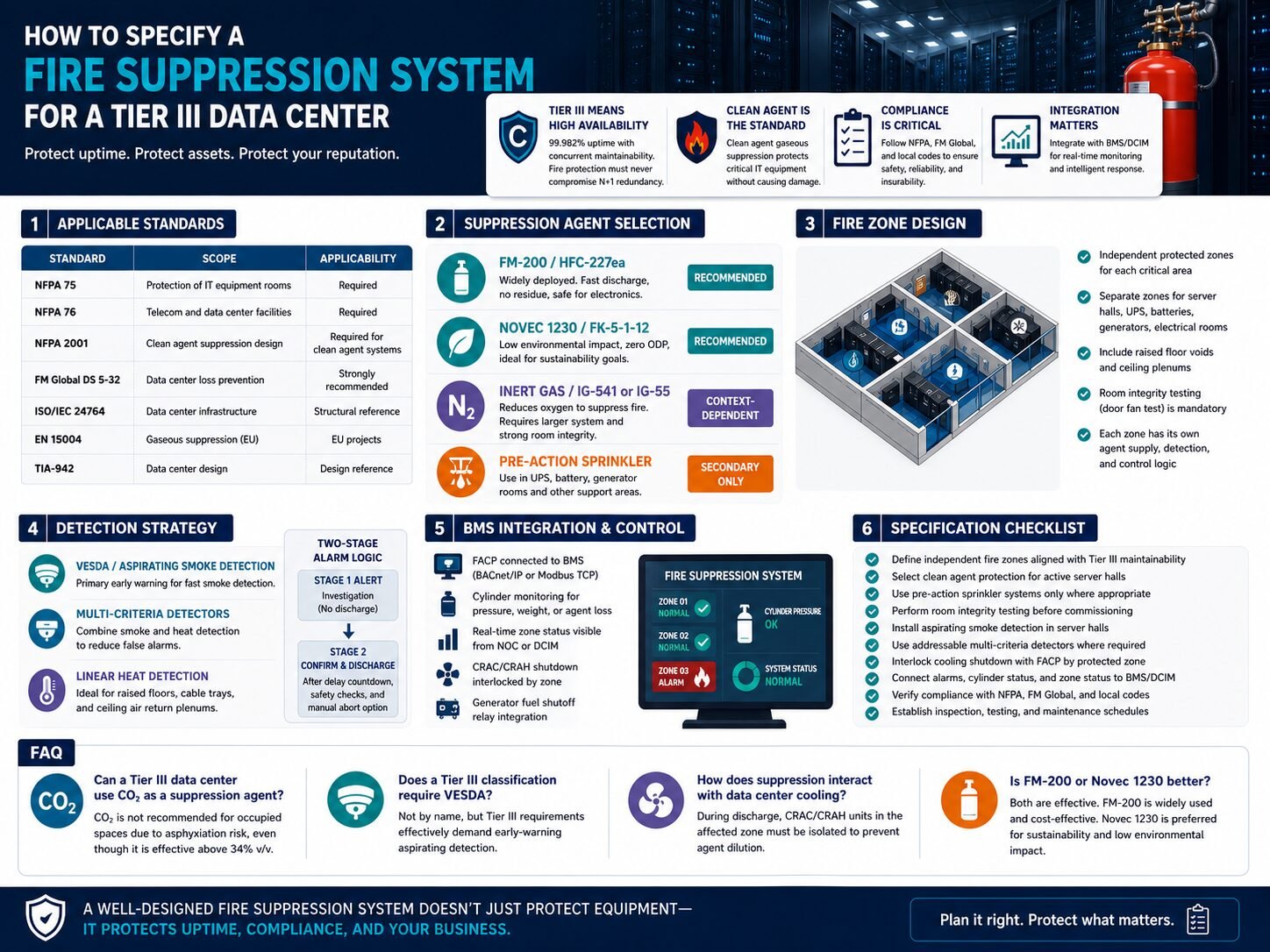
A Tier III data center requires a clean agent gaseous suppression system — most commonly FM-200 (HFC-227ea), Novec 1230, or inert gas (IG-541/IG-55) — installed in each independent fire zone. The system must comply with NFPA 75 and NFPA 76, operate concurrently with active cooling and power, and suppress fire without damaging electronic equipment or disrupting uptime. Pre-action sprinkler systems serve as a secondary layer in structural and mechanical areas.
Tier III
NFPA 75 – NFPA 76 – NFPA 2001- FM Global DS 5-32
FM-200- Novec 1230 – VESDA –TIA – 942
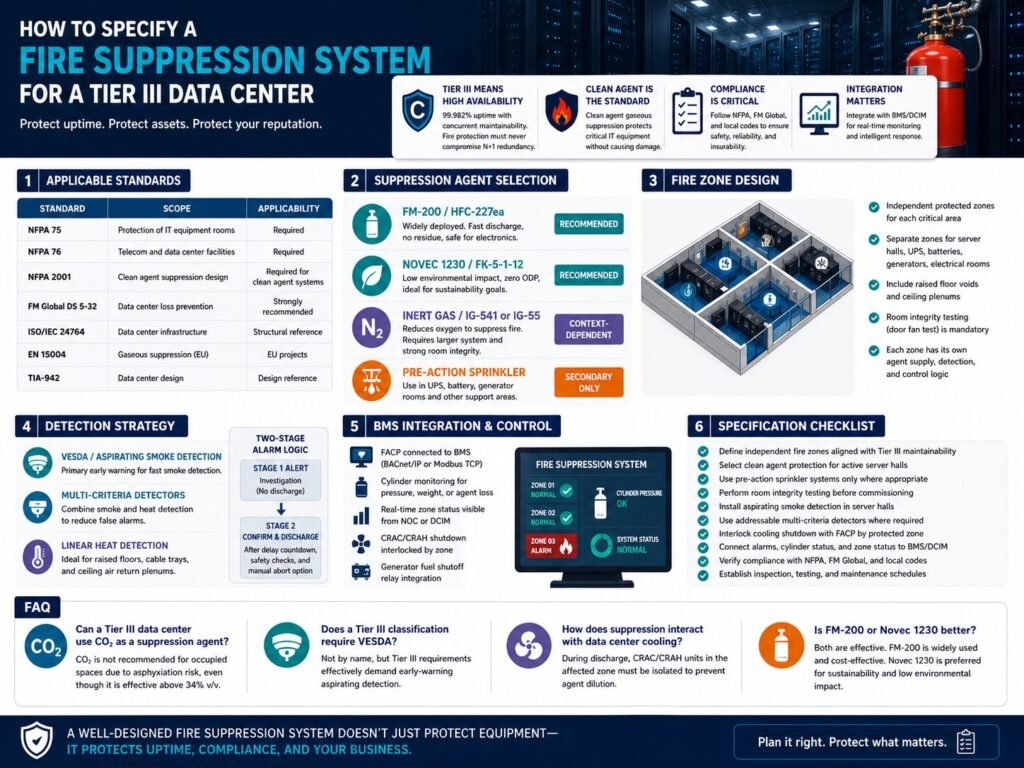
1. fire suppression system forTier III data center Fire Risk Constraints
Tier III facilities must support concurrent maintainability, meaning any component can be isolated for maintenance without disrupting IT operations. This applies directly to fire protection: the suppression system must be maintainable without a system-wide shutdown.
Compared to Tier I and Tier II sites, a Tier III data center carries higher fire load complexity. Multiple active power paths and redundant cooling mean denser cabling, more infrastructure in raised floor voids, and separate fire zones required for UPS rooms, battery rooms, and generator areas.
The Uptime Institute does not mandate a specific suppression technology. It requires that the fire protection strategy does not compromise the N+1 redundancy and concurrent maintainability principles of a Tier III site.
2. Applicable Standards and Codes
Establish the governing standards framework before selecting any agent or system type. For most global Tier III projects:
| Standard | Scope | Applicability |
|---|---|---|
| NFPA 75 | Protection of IT equipment rooms | Required |
| NFPA 76 | Telecom and data center facilities | Required |
| NFPA 2001 | Clean agent suppression design | Required for clean agent systems |
| FM Global DS 5-32 | Data center loss prevention | Strongly recommended |
| ISO/IEC 24764 | Data center infrastructure | Structural reference |
| EN 15004 | European gaseous suppression | EU projects |
| TIA-942 | Data center design | Design reference |
3. Data Center suppression agent selection
Wet pipe sprinklers are not ideal in active server rooms due to collateral water damage risk. For suppression systems for data centers the preferred choice is a clean agent gaseous suppression system, while sprinklers are usually reserved for structural corridors and non-critical mechanical areas.
FM-200 / HFC-227ea
Widely deployed globally. Fast discharge, no residue, safe for electronics, and compliant with NFPA 2001.
Novec 1230 / FK-5-1-12
Low environmental impact, zero ODP, and preferred for projects with sustainability or green building requirements.
Recommended
Inert Gas / IG-541 or IG-55
Reduces oxygen concentration to suppress fire. Requires larger cylinder banks and strong room integrity.
Context-Dependent
Pre-Action Sprinkler
Useful for UPS, battery, and generator rooms, but should not be the only protection layer in active server halls.
Secondary Only
4. Fire Zone Design and Room Integrity
A Tier III site requires independent protected zones. Each zone should be a sealed compartment with its own agent supply, detection circuit, and control logic.
- Server halls or modular rows with independent suppression zones
- UPS and battery rooms separated due to Class B fire and off-gas risk
- Generator rooms with suppression and fuel shutoff relay interlock
- Electrical switch rooms and MV/LV distribution panels
- Raised floor voids when cable density creates additional fire load
- Above-ceiling plenums used for return air or cable routing
Room integrity testing, commonly performed through a door fan test, is mandatory before commissioning. The protected room must hold the agent concentration long enough to suppress the fire and prevent reignition.
5. Detection: VESDA and Multi-Criteria Systems
A layered detection strategy is essential. A single spot detector does not provide enough lead time for the slow-developing failures commonly found in server hardware, cabling, and electrical panels.
- Aspirating Smoke Detection / VESDA as the primary early-warning layer
- Addressable multi-criteria detectors combining optical and heat detection
- Linear heat detection cables in raised floor voids and ceiling plenums
The system should use a two-stage alarm logic. Stage 1 triggers investigation without discharge. Stage 2 activates suppression after confirmation, delay countdown, and safety checks.
Abort buttons should be installed at zone exits and configured according to the applicable clean agent suppression standard and local authority requirements.
6. BMS Integration and Remote Monitoring
The suppression system should be integrated with the Building Management System or DCIM platform to provide real-time visibility of cylinder pressure, zone status, valve positions, alarms, and maintenance events.
- FACP connected to BMS via BACnet/IP or Modbus TCP
- Cylinder monitoring for pressure, weight, or agent loss
- Zone status visible from the NOC or remote monitoring platform
- CRAC/CRAH shutdown interlocked by zone during confirmed alarm
- Generator fuel shutoff relay integration when applicable
7. Frequently Asked Questions
Which fire suppression system is used in data centers?
Data centers use clean agent gaseous suppression systems as the primary technology. The most common options are:
- FM-200 (HFC-227ea) — the most widely deployed globally, discharges in ~10 seconds, leaves no residue
- Novec 1230 (FK-5-1-12) — preferred for LEED/BREEAM facilities, GWP of 1
- Inert gases (IG-541 / IG-55) — oxygen-reduction approach, no chemical agents
- Pre-action sprinkler — used as a secondary layer in UPS rooms, generator rooms, and mechanical areas, never as the sole system in active server halls
Wet pipe sprinklers are disqualifying in active server rooms due to water damage risk to equipment.
Is Halon still used in data centers?
No, Halon has been effectively phased out. The Montreal Protocol (1987) banned production of Halon 1301 and Halon 1211 due to their ozone-depleting potential (ODP). Stockpiles from recovered/recycled Halon still exist in some legacy systems in certain countries, but:
- New installations do not use Halon
- Most jurisdictions prohibit new Halon systems
- Insurance providers (including FM Global) do not approve Halon for new data center specifications
- FM-200 and Novec 1230 were developed specifically as Halon replacements, offering comparable suppression speed with zero ODP
Any existing data center still running a Halon system is operating on aging infrastructure that is out of compliance with current standards (NFPA 2001, FM Global DS 5-32) and should be retrofitted.
CO2 is not recommended for occupied spaces. Although it is effective as a suppression agent, the asphyxiation risk makes it unsuitable for server rooms and other areas where personnel may be present.
Tier III does not require VESDA by brand name, but high-availability facilities usually need aspirating smoke detection or equivalent early-warning detection to reduce risk before visible smoke or flame develops.
During discharge, airflow in the affected zone must be controlled so the agent is not diluted. The fire alarm control panel should interlock with the BMS to shut down cooling equipment only in the affected zone whenever possible.
Both can be used in data center environments. FM-200 is widely installed and cost-effective, while Novec 1230 is often preferred for projects with stronger sustainability requirements or stricter environmental regulations.
8. Specification Checklist
Before design freeze, validate your fire suppression specification against these points:
- Define independent fire zones aligned with Tier III maintainability
- Select clean agent protection for active server halls
- Use pre-action sprinkler systems only where appropriate
- Perform room integrity testing before commissioning
- Install aspirating smoke detection in server halls
- Use addressable multi-criteria detectors where required
- Interlock cooling shutdown with the FACP by protected zone
- Connect alarms, cylinder status, and zone status to BMS/DCIM
- Verify compliance with NFPA, FM Global, and local codes
- Establish inspection, testing, and maintenance schedules
Need a fire suppression specification for your data center?
Blue BMS helps critical facilities source reliable fire suppression, fire detection, and monitoring solutions for high-availability environments.