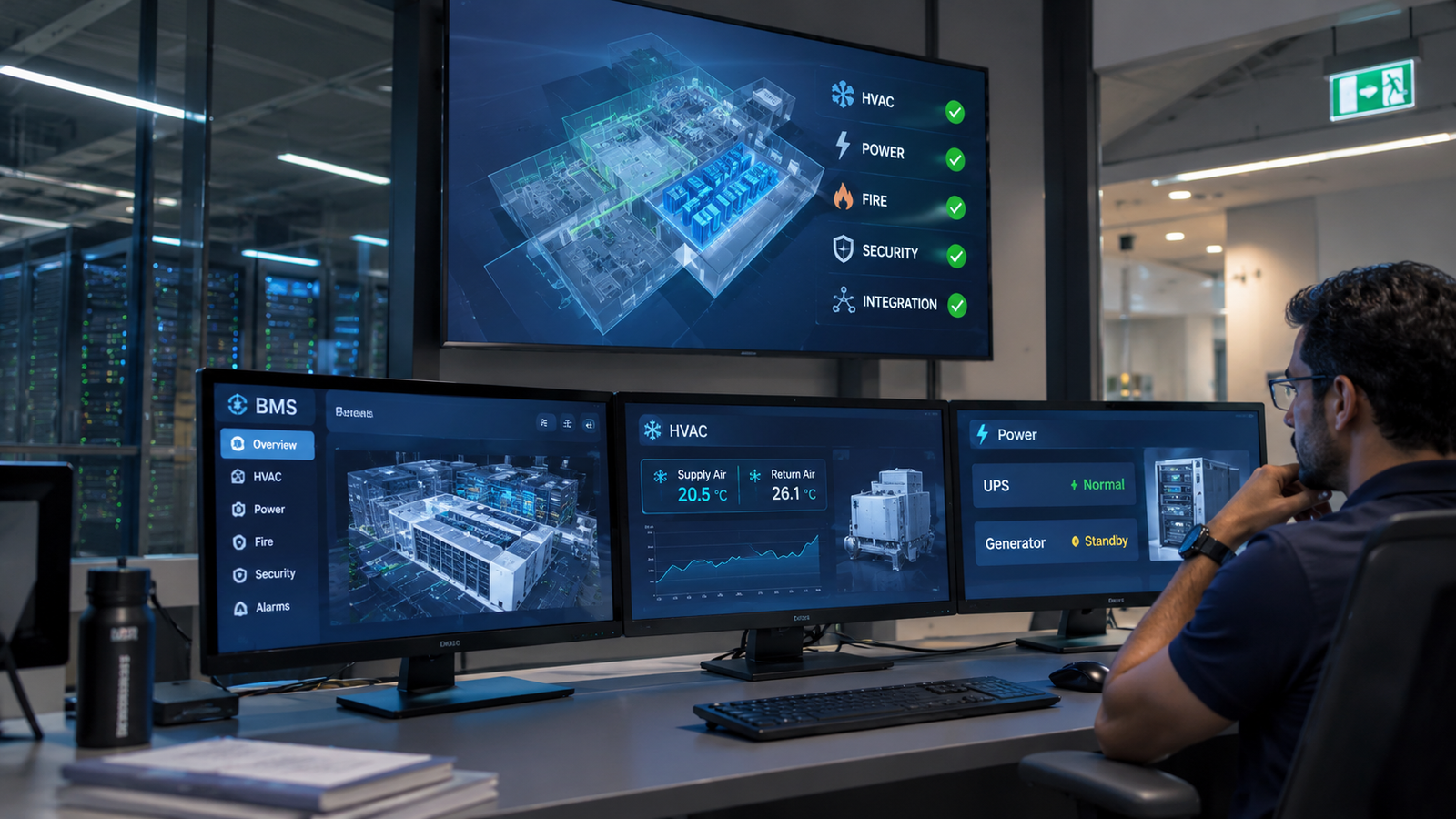
A building management system (BMS) in a mission critical facility automates, monitors and integrates cooling, power, fire and security systems so the site never stops. In data centers it holds IT inlet air within ASHRAE’s 18–27 °C recommended range and raises alarms in seconds. In commercial buildings it protects critical zones such as operating rooms, trading floors and control rooms.
What a BMS does in a mission critical facility
This BMS mission critical facilities guide explains how a building management system keeps 24/7 sites running, and how to specify one.
A BMS, also called a building automation system (BAS), is the control layer that ties a building’s systems together. It reads thousands of sensors, runs control sequences and alerts operators when something drifts out of range.
A facility is mission critical when an interruption causes major financial, safety or service losses. Typical examples are data centers, hospitals, airports, telecom exchanges, financial operations centers and industrial control rooms. In these sites the BMS is not a comfort system. It is part of the uptime strategy.
Why BMS mission critical facilities projects are different
Downtime is expensive, energy demand is climbing and skilled staff are scarce, so the BMS has to do more with less human input.
| Pressure | Latest data | What it means for the BMS |
|---|---|---|
| Cost of downtime | 57% of operators said their last major outage cost over US$100,000; about 1 in 5 said over US$1 million (Uptime Institute) | Fast, prioritized alarms and automatic failover sequences |
| Main outage causes | Power is the leading cause; not following procedures is the top human-error driver | Monitor UPS, transfer switches and generators; automate routine procedures |
| Energy demand | Data centers used about 415 TWh in 2024 (~1.5% of global electricity), heading to 945 TWh by 2030 (IEA via S&P Global) | Optimize the cooling plant and track efficiency (PUE) continuously |
| Efficiency plateau | Average PUE has been mostly flat for five years, at 1.56 in 2024 (Upsite on Uptime data) | Use trending and analytics to find savings, not just alarms |
| Higher rack density | More operators report peak racks of 30 kW or more (Uptime Institute 2026 survey) | Monitor liquid cooling loops, leak detection and hot spots |
| Staffing gap | More than half of operators struggle to hire qualified staff | Automation and clear dashboards reduce reliance on manual checks |
In short, BMS mission critical facilities deployments are judged on uptime first and energy second, while a standard commercial BMS is judged mostly on comfort and cost.
The 3 pillars of BMS mission critical facilities: automation, monitoring and integration
Across BMS mission critical facilities projects, the system does three jobs. It acts on its own, it watches everything, and it shares data with the other systems that protect the facility.
Automation: let the system act before people need to
- Plant sequences: chiller staging, pump and fan speed control, free-cooling changeover and lead/lag rotation of redundant equipment.
- Failure response: when a cooling unit trips, the BMS starts the standby unit and adjusts setpoints elsewhere to protect the IT load.
- Setpoint optimization: supply air and chilled water temperatures reset to the real load, not to a fixed worst case.
- Scheduling (commercial sites): HVAC and lighting follow occupancy. PNNL found that fully using building controls could cut U.S. commercial building energy use by 29% on average.
Monitoring: see problems while they are still small
- Environment: temperature, humidity and differential pressure at rack inlets, rooms and air handlers.
- Water and leaks: chilled water flow, liquid cooling loops and leak detection cable under raised floors.
- Power status: UPS, generator, transfer switch and battery alarms, usually received from the electrical monitoring system.
- Life safety status: fire alarm, VESDA aspirating smoke detection and lithium-ion off-gas detection in battery rooms.
- Alarm management and trends: priorities, escalation and historical trends, ideally with fault detection and diagnostics (FDD).
Integration: one view across systems
Integration brings BMS, power, IT and security data into one operator view. Common links are:
- Open protocols: BACnet (IP or Secure Connect), Modbus TCP and SNMP for UPS units and PDUs.
- Electrical (EPMS) and IT (DCIM) platforms: share alarms and key values so operators do not switch between screens.
- Fire alarm and suppression: status from the fire panel and clean agent suppression systems through a listed gateway.
- Security: access control and video security events linked to rooms and alarms.
How the layers fit together
- Field level: sensors, meters, valves, actuators and variable-speed drives.
- Automation level: DDC controllers or PLCs, redundant for critical plant.
- Network level: BACnet/IP or BACnet/SC on a segmented operational technology (OT) network.
- Supervisory level: redundant servers, graphics, alarms and trend history.
- Enterprise level: links to EPMS, DCIM, maintenance software (CMMS) and analytics.
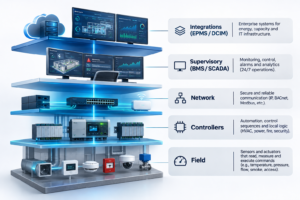
The five layers of a mission critical BMS.
BMS vs DCIM vs EPMS: who does what
A BMS controls the building, an EPMS watches the electrical system at millisecond speed, and DCIM manages the IT white space. In most BMS mission critical facilities projects, all three run side by side.
| Criterion | BMS | EPMS | DCIM |
|---|---|---|---|
| Main scope | HVAC, chillers, air handlers, lighting, leaks, building alarms | Switchgear, UPS, generators, PDUs, power quality | Racks, IT assets, rack power, capacity, inventory |
| Controls equipment? | Yes | Mostly monitors | No, monitors and plans |
| Data speed | Seconds to minutes | Milliseconds; captures sub-cycle events with time stamps | Device-level trends over time |
| Main users | Facilities team | Electrical and facilities teams | IT and data center managers |
| Typical protocols | BACnet, Modbus, LonWorks | Modbus TCP, IEC 61850, SNMP | IP-based, SNMP |
| Role in uptime | Keeps cooling and environment stable | Finds the root cause of power events; manages N+1 and 2N capacity | Plans capacity and supports predictive maintenance |
The BMS is not built to log power quality events, which is why an EPMS is added for electrical detail (Data Center Frontier). Good practice is to pass only major alarms and key values between DCIM and the BMS (TechTarget).
BMS mission critical facilities by sector: data centers vs commercial buildings
Data centers protect IT load; commercial mission critical buildings protect people and specific critical zones. The BMS priorities follow from that.
| Criterion | Data centers | Commercial mission critical buildings |
|---|---|---|
| What must not fail | Cooling and power for IT equipment | Critical zones: operating rooms, isolation rooms, trading floors, control rooms, emergency systems |
| Key environmental targets | IT inlet air 18–27 °C (ASHRAE recommended), non-condensing humidity | Room pressure relationships, air changes, temperature and comfort |
| Redundancy | N+1 or 2N cooling and power; redundant BMS controllers and servers | N+1 on critical plant; emergency power for life safety |
| Key integrations | EPMS, DCIM, VESDA, leak detection, clean agent suppression | Fire alarm, access control, video, lighting, elevators |
| Main references | ASHRAE TC 9.9, ASHRAE 90.4, TIA-942, NFPA 75/76 | ASHRAE 170 (healthcare ventilation), NFPA 72, NFPA 99, local codes |
| Typical KPIs | Uptime, PUE, inlet temperature compliance | Energy use intensity, alarm response time, comfort complaints |
Data centers: where the BMS meets AI-era density
Higher rack densities push more sites toward liquid cooling. The BMS then needs points on coolant distribution units, flow, pressure and leak detection, not only on air. Pairing the BMS with an EPMS and DCIM gives operators one view from the utility feed to the rack.
Commercial buildings: protect critical zones, save energy everywhere else
In a hospital or airport, only part of the building is truly mission critical. The BMS keeps those zones on strict control and redundant plant, while scheduling and setpoint resets cut energy in offices, retail areas and public spaces.
Standards, protocols and cybersecurity
BMS mission critical facilities projects must follow thermal, energy, life safety and cybersecurity standards at the same time.
| Standard / protocol | What it covers | Why it matters for the BMS |
|---|---|---|
| ASHRAE TC 9.9 Thermal Guidelines | Recommended IT inlet range of 18–27 °C (Data Center Frontier) | Defines setpoints and alarm limits for the white space |
| ASHRAE 90.4 | Energy standard for data centers | Sets efficiency targets the BMS helps prove |
| ASHRAE 135 (BACnet) and BACnet/SC | Open building automation protocol; Secure Connect adds TLS 1.3 encryption and certificate-based mutual authentication (ASHRAE) | Lets multi-vendor systems talk securely over IP |
| ISA/IEC 62443 | Cybersecurity for automation and control systems, adopted by BMS suppliers (ISASecure) | Framework for securing controllers, networks and suppliers |
| NFPA 72 and UL 864 (UUKL) | Fire alarm signaling; listing for smoke control equipment (CSE Magazine) | Fire alarm keeps priority; a BMS used in smoke control must be listed |
| TIA-942 / Uptime Tier levels | Data center redundancy topology | Drives how redundant the BMS itself must be |
| ASHRAE 170 | Ventilation of healthcare facilities | Sets pressure and air change rules the BMS must hold |
Cybersecurity basics for a mission critical BMS
- Put the BMS on a segmented OT network, separate from corporate IT and guest Wi-Fi.
- Specify BACnet/SC for new IP installations and encrypt remote access.
- Remove default passwords, use role-based accounts and log every change.
- Ask suppliers for IEC 62443-aligned products and a patching plan.
- Never place controllers directly on the public internet.
BMS mission critical facilities checklist: 8 best practices
Use these eight steps when you specify, upgrade or audit a BMS for a critical site.
- Map critical loads and failure modes first. List what must never stop and how each system can fail before choosing hardware.
- Make the BMS itself redundant. Use redundant controllers for critical plant, redundant servers, ring networks and UPS-backed control panels.
- Choose open protocols. Specify BACnet/IP or BACnet/SC, Modbus and SNMP to avoid lock-in to one vendor.
- Plan EPMS and DCIM integration. Agree which alarms and values each system shares, and who owns each alarm.
- Connect life safety the right way. Receive fire alarm status through a listed gateway, and keep the fire alarm system in charge of life-safety actions.
- Design alarm management. Set priorities, suppress nuisance alarms and define escalation, so a real event is never lost in an alarm flood.
- Build in cybersecurity from day one. Follow IEC 62443 principles, segment the network and control remote access.
- Commission and test integrated sequences. Run integrated systems testing (IST) that simulates real failures, then train operators and keep documentation current.
Bottom line Following this checklist makes every BMS mission critical facilities project easier to operate, audit and expand.
FAQ: BMS mission critical facilities
What is a BMS in a mission critical facility?
It is the building management system that automates, monitors and integrates cooling, power status, fire, security and other building systems in a site that cannot afford downtime, such as a data center, hospital or airport.
What is the difference between a BMS and DCIM?
A BMS controls building systems like HVAC, chillers and lighting. DCIM monitors IT assets, rack power and capacity in the white space. Most data centers use both and share key alarms between them.
Does a data center need both a BMS and an EPMS?
Usually yes. A BMS is not designed to capture fast power quality events. An EPMS records electrical events in milliseconds, which helps find the root cause of an outage and manage N+1 or 2N capacity.
Can a BMS control the fire alarm system?
No. The fire alarm system keeps priority over life-safety functions. The BMS can receive fire alarm status through a listed gateway, and a BMS used for smoke control must be UL 864 listed for that purpose (UUKL).
Which protocols should a mission critical BMS support?
At minimum BACnet (BACnet/IP or the encrypted BACnet/SC), Modbus TCP and SNMP. These open protocols let the BMS connect chillers, UPS units, PDUs and meters from different manufacturers.
How does a BMS reduce downtime?
It detects problems early, starts standby equipment automatically and sends prioritized alarms. It also logs trends that help teams fix recurring faults before they cause an outage.
How much energy can a BMS save in commercial buildings?
A PNNL study estimated that fully using building controls could cut U.S. commercial building energy use by 29% on average. Real savings depend on the building and how well the controls are tuned.
Conclusion: build the BMS around uptime
In BMS mission critical facilities, the building management system is part of the uptime strategy, not an add-on. Automation reacts to failures in seconds, monitoring catches problems while they are small, and integration gives operators one view across cooling, power, fire and security.
Start with critical loads and failure modes, choose open and secure protocols, and test every integrated sequence before go-live.
Planning a BMS for a data center or critical commercial building?
Blue BMS supplies building automation platforms such as Johnson Controls Metasys and Honeywell, together with fire detection, gas detection, suppression and security systems for critical facilities worldwide.
Sources
- Uptime Institute Annual Outage Analysis 2026 — ITWeb
- Uptime Institute 16th Annual Global Data Center Survey (2026) — 01net
- Rack density rises while PUE remains flat — Upsite
- Global data center power demand to double by 2030 (IEA) — S&P Global
- Cut U.S. commercial building energy use 29% with widespread controls — PNNL
- Protecting building automation systems with BACnet Secure Connect — ASHRAE
- BACnet Secure Connect — BACnet International
- IEC 62443 for building automation systems — ISASecure
- Integration: building automation and fire alarms — CSE Magazine
- Understanding data center temperature guidelines — Data Center Frontier
- Benefits of integrating BMS and EPMS — Data Center Frontier
- Know your data center monitoring system — TechTarget