The four main server room fire suppression options are FM-200 (HFC-227ea), Novec 1230 / FK-5-1-12, CO2 and inert gas (IG-541, IG-55). For new server rooms in 2026, FK-5-1-12 and inert gas are the leading choices. FM-200 faces HFC phase-down rules in the US and EU. CO2 is unsafe for normally occupied IT spaces.
Why the choice of agent matters in a server room
Choosing between server room fire suppression options decides three things: whether staff can stay safe during a discharge, how fast IT equipment returns to service, and whether your system will still be refillable in ten years.
Water sprinklers protect the building, but they can destroy live electronics. Gaseous agents put out the fire without wetting equipment or leaving residue. That is why data centers rely on them for white space, UPS rooms, battery rooms and network closets.
The market has also shifted. 3M stopped making Novec 1230 at the end of 2025 as part of its exit from PFAS chemistry. FM-200 is an HFC under the US AIM Act phase-down. A comparison of server room fire suppression options written five years ago will steer you wrong today.
Server room fire suppression options compared: FM-200 vs Novec 1230 vs CO2 vs inert gas
Across the four server room fire suppression options, FK-5-1-12 offers the widest human safety margin of the chemical agents, inert gas has zero climate impact, and CO2 is the only option ruled out for occupied IT rooms.
| Criterion | FM-200 (HFC-227ea) | Novec 1230 / FK-5-1-12 | CO2 | Inert gas (IG-541, IG-55) |
|---|---|---|---|---|
| How it works | Absorbs heat | Absorbs heat | Displaces oxygen | Lowers oxygen to about 12–15% |
| Typical design concentration (Class A) | About 6.7–8.7% | About 4.2–6% | About 34% or higher | About 34–52% |
| NOAEL (safe exposure limit) | 9% | 10% | Lethal at design concentration | Up to 52% for brief egress |
| Safe for normally occupied spaces | Yes, narrow margin | Yes, wide margin | No | Yes, at ≤52% |
| Discharge time (NFPA 2001 / NFPA 12) | 10 s | 10 s | Up to about 60 s | 60 s |
| Global warming potential (GWP) | 3,220 | 1 | 1 | 0 |
| Regulatory outlook 2026 | HFC phase-down (US AIM Act); restricted for new equipment in EU | Not an HFC; 3M exited, generics available; PFAS scrutiny | Restricted by NFPA 12 to normally unoccupied spaces | No phase-down risk |
| Storage footprint | Compact (liquid) | Compact (liquid) | Medium | Large (200–300 bar cylinders) |
| Pipe runs / remote storage | Short | Short | Medium | Long; cylinders can sit far from the room |
| Main data center caveat | Refill cost and availability rising | Verify listing of generic fluid with your system | Life-safety lockout and evacuation required | Silent nozzles to protect hard drives; pressure venting |
Values are typical ranges from manufacturer data and NFPA 2001 design guidance; your listed system’s design manual sets the final figures. Safety margin sources: NYC DOB FK-5-1-12 acceptance, Fike inert gas data, Safety Hi-Tech on EU 2024/573.
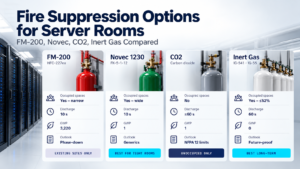
Server room fire suppression options at a glance.
The 4 server room fire suppression options explained
FM-200 (HFC-227ea): proven, but on a regulatory clock
FM-200 is a hydrofluorocarbon clean agent that cools the flame chemically and physically. It reaches extinguishing concentration in 10 seconds and leaves no residue. For two decades it was the default among server room fire suppression options.
- Pros: fast 10-second discharge; compact liquid storage; huge installed base and trained service network.
- Cons: GWP of about 3,220; design concentration close to its 9% NOAEL, so the safety margin is narrow.
- Regulatory status: FM-200 is one of the HFCs regulated by the EPA under the AIM Act. The phase-down limits production, so refill costs keep rising. In the EU, Regulation 2024/573 bans placing new HFC fire protection equipment on the market from 1 January 2025, unless site safety rules require it.
Bottom line Existing FM-200 systems can stay in service. For new projects, most engineers now specify an alternative.
Novec 1230 / FK-5-1-12: the halocarbon successor
Novec 1230 is 3M’s brand for the fluoroketone FK-5-1-12. It is stored as a liquid, discharges as a gas in 10 seconds and absorbs heat until the fire goes out.
- Pros: design concentration of roughly 4.2–6% against a 10% NOAEL, the widest margin among chemical agents; GWP of 1; atmospheric lifetime of a few days; fits in a footprint similar to FM-200.
- Cons: it is a PFAS-class chemical, so it faces future scrutiny; the 3M brand is gone and buyers must verify the generic fluid.
- Regulatory status: 3M ended production with its PFAS exit, but the 3M patent expired and generic FK-5-1-12 is UL listed and FM approved. Suppliers such as Fike (SF 1230) and Kidde (Fluoro-K) now offer it. FK-5-1-12 is not an HFC, so the AIM Act phase-down does not apply.
Bottom line The best fit when floor space is tight and the room is normally occupied. Confirm the fluid is listed with your specific system hardware.
CO2: effective, cheap and dangerous to people
Carbon dioxide puts out fire by displacing oxygen. It is inexpensive, electrically non-conductive and leaves no residue, which is why some vendors still market it for IT rooms.
- Pros: low agent cost; works on deep-seated fires; widely available.
- Cons: at its design concentration of about 34% or more, CO2 causes rapid unconsciousness and death. NFPA 12 requires warning signs, lockout valves, pre-discharge delays and full evacuation. CO2 can also migrate into adjacent spaces.
- Regulatory status: NFPA 12 states CO2 systems should not be installed in normally occupied rooms.
Bottom line Do not use CO2 in server rooms or data halls where people work. It belongs in unmanned spaces such as some generator or cable enclosures, with full life-safety controls.
Inert gas (IG-541 Inergen, IG-55 Argonite/ProInert, IG-100, IG-01): zero-GWP and future-proof
Inert gas systems discharge nitrogen, argon or a blend into the room. They lower oxygen to about 12–15%, enough to stop combustion but still breathable for a short escape. IG-541 also contains a small share of CO2, which raises breathing rate.
- Pros: zero ozone depletion and zero global warming potential; no phase-down risk; natural gases are cheap to refill; cylinders can sit far from the protected room with long, small-diameter pipe runs.
- Cons: needs many more cylinders stored at 200–300 bar; 60-second discharge instead of 10; rooms need pressure relief vents; discharge noise can damage hard drives.
- Hard drive risk: discharge noise can cause the performance of spinning hard drives to decay. A 2018 inert gas release at a Nasdaq Nordic data center in Sweden crashed servers and took the exchange offline. Specify silent or acoustic nozzles and pressure-regulated valves, such as Siemens Sinorix Silent Extinguishing Technology.
Bottom line Of all server room fire suppression options, inert gas is the most sustainable long-term choice for new data centers with space for a cylinder room.
How to choose the right option for your data center
Narrowing down server room fire suppression options starts with occupancy, then space, then regulatory horizon. In most new builds that path leads to FK-5-1-12 or inert gas.
| If your server room… | Best-fit option | Why |
|---|---|---|
| Is normally occupied and short on floor space | FK-5-1-12 | Widest safety margin and smallest footprint |
| Has room for a cylinder bank, or storage can sit far away | Inert gas (IG-541 / IG-55) | Zero GWP, no phase-down risk, low refill cost |
| Already runs FM-200 and is in good condition | Keep FM-200, plan the transition | Discharge is allowed; budget for refill cost or a retrofit |
| Is a normally unoccupied enclosure (e.g. some cable vaults) | CO2, with full NFPA 12 controls | Only acceptable where people are not present |
| Uses spinning hard drives (HDD storage arrays) | Any gaseous agent with silent nozzles | Discharge noise can damage drives |
| Is located in the EU | FK-5-1-12 or inert gas | New HFC fire protection equipment is restricted since 2025 |
Five more checks apply whatever agent you pick:
- Room integrity. A door fan test must show the room can hold design concentration for at least 10 minutes.
- Pressure relief. Both inert gas and halocarbon discharges change room pressure; size vents to protect walls and raised floors.
- Early detection. Pair suppression with aspirating smoke detection (VESDA-type) so the system acts at the incipient stage.
- Total cost of ownership. Compare installation, annual inspection, refill after discharge and downtime, not just the agent price.
- Authority having jurisdiction (AHJ) and insurer. Some insurers still require a pre-action sprinkler system alongside the gaseous system.
Standards and regulations that apply
All server room fire suppression options must follow recognized standards: NFPA 2001 governs clean agent and inert gas systems in the US, NFPA 12 governs CO2, and ISO 14520 and EN 15004 are the international equivalents.
| Standard / rule | Scope | What it means for server rooms |
|---|---|---|
| NFPA 75 | Fire protection of IT equipment | Sets when IT rooms need suppression and how to protect them |
| NFPA 76 | Telecommunications facilities | Recommends early-warning aspirating detection for high-value spaces |
| NFPA 2001 | Clean agent and inert gas systems | Design concentration, 10 s / 60 s discharge, 10-minute hold time, occupied-space limits |
| NFPA 12 | CO2 systems | Lockout, signage, pre-discharge delay; not for normally occupied rooms |
| ISO 14520 / EN 15004 | Gaseous extinguishing systems (international / EU) | Agent-specific design parts, e.g. IG-55 and FK-5-1-12 |
| US AIM Act (EPA) | HFC production phase-down | Rising cost and shrinking supply of virgin FM-200 |
| EU Regulation 2024/573 (F-gas) | HFC equipment bans and technician certification | New HFC fire protection equipment restricted from 1 Jan 2025; certification now also covers FK-5-1-12 systems |
Sources: NFPA overview, S7 Risk on the AIM Act, EU Implementing Regulation 2025/625 summary.
FAQ: server room fire suppression options
What are the main server room fire suppression options?
The main server room fire suppression options are FM-200 (HFC-227ea), Novec 1230 / FK-5-1-12, CO2 and inert gas blends such as IG-541 and IG-55. All four are gaseous agents that put out fires without water damage to IT equipment.
What is the best fire suppression system for a server room?
For most new server rooms, FK-5-1-12 (the generic of Novec 1230) or an inert gas system is the best choice. FK-5-1-12 suits small, occupied rooms with little storage space. Inert gas suits larger sites that want zero climate impact and no phase-down risk.
Is FM-200 being banned?
FM-200 is not banned for use, but its production is being phased down under the US AIM Act. In the EU, new HFC fire protection equipment has been restricted since 1 January 2025. Existing systems can stay in service, but refills are getting more expensive.
Is Novec 1230 still available after 3M stopped making it?
3M ended production by the end of 2025. The same chemical, FK-5-1-12, is now sold by several manufacturers and is UL listed and FM approved. Check that the fluid is listed for your specific system.
Is a CO2 fire suppression system safe for a server room?
No, not if people work there. CO2 is lethal at the concentration needed to put out a fire. NFPA 12 limits it to normally unoccupied spaces with lockout and evacuation controls.
Is inert gas safe for people?
Yes, at design concentrations up to 52%. Inert gas lowers oxygen to about 12–15%, which stops combustion but still allows people to evacuate. Systems still use pre-discharge alarms so the room is cleared.
Can a fire suppression discharge damage hard drives?
Yes. The noise of a gas discharge can damage spinning hard drives. Silent or acoustic nozzles and pressure-regulated valves reduce that risk.
How long does a clean agent system take to discharge?
Halocarbon agents such as FM-200 and FK-5-1-12 discharge in 10 seconds. Inert gas systems take about 60 seconds. Both must hold concentration for at least 10 minutes.
Conclusion: the best server room fire suppression options for 2026
Among today’s server room fire suppression options, FK-5-1-12 and inert gas are the two safe, future-proof paths for new data center projects. FM-200 remains a valid system for existing installations, but its cost and availability will keep tightening. CO2 has no place in rooms where people work.
The right answer depends on your room’s occupancy, available space, storage hardware and local regulations. A short engineering review before you buy avoids costly retrofits later.
Comparing server room fire suppression options for your data center?
Blue BMS supplies fire detection and gaseous fire suppression solutions for critical facilities worldwide, from our US headquarters and European hub. Tell us about your room and we’ll help you specify the right agent.
Sources
- 3M Novec 1230 Phase Out: Fire Suppression Alternatives — FireAlarm.com
- 3M Novec 1230 Discontinued: What Now? — Fike
- Alternative chemical agent to Novec 1230 — MeyerFire
- HFC-Based Clean Agent Fire Suppression Systems — S7 Risk
- FM-200 extinguishing agent being phased down — Professional Mariner / US Coast Guard
- EU unveils new F-gases regulation — ChemLinked
- Regulation EU 2024/573 — Safety Hi-Tech
- EU Implementing Regulation 2025/625 — Europalov
- Fire Detection & Suppression in Data Centres — open-exam-prep
- CO2 Fire Extinguishing System Design and Safety — IPM
- IG-541 Inert Gas Agent datasheet — Fike
- FK-5-1-12 equipment acceptance MEA 118-06-E — NYC Department of Buildings
- Clean agent design concentration and room integrity — Engineers Universe
- Acoustic performance of clean agent nozzles — Applied Sciences (2022)
- Noise from gas blast destroys Digiplex disk drives — The Register (2018)
- Sinorix Silent Extinguishing Technology — Siemens