Fire Detection · Retrofit & Lifecycle · Updated June 2026 · Reviewed by Blue BMS Technical Team
What Is the AutroGuard Retro Spare Part Detector?
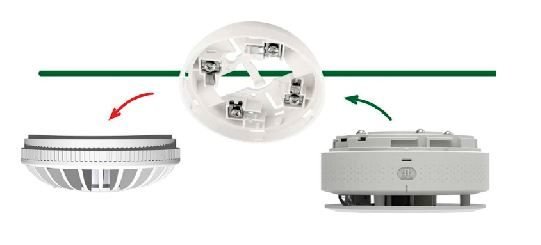
When an installed optical smoke detector reaches end of life on an Autronica fire detection system, the engineer’s question is rarely “which new detector is best?” — it is “how do I replace this point without rewiring the loop, re-addressing the panel, or revalidating the configuration?” The AutroGuard Retro spare part detector is engineered to answer exactly that. It is a one-to-one replacement detector that drops onto your existing Autronica base and behaves, to the panel, like the legacy unit it replaces — while delivering the modern multicriteria detection performance of the AutroGuard® V-430 platform underneath.
Part number 116-BHH-300/SPARE (model name V-430/BH300) is the specific AutroGuard Retro variant that replaces the legacy 116-BHH-300 optical smoke detector. It mounts directly onto the existing BWA-100 / BWA-101 base, requires no firmware upgrade and no re-configuration, and is fully compatible with AutroSafe 3 (version 3.6 and higher), AutroSafe 4 (all versions), and Autroprime (all versions).
The Autronica 116-BHH-300/SPARE is the AutroGuard Retro variant that replaces the legacy 116-BHH-300 optical smoke detector on a 1:1 basis. It reuses the existing BWA-100/BWA-101 base, needs no software upgrade or re-addressing, and provides AutroGuard V-430 multicriteria detection (EN 54-7 optical smoke, with DYFI³D and SelfVerify®). The panel and PowerCalc continue to use the original legacy unit’s electrical values.
EN 54-7:2018 OpticalEN 54-17 Short-circuit IsolatorDYFI³DSelfVerify®Cover DetectionNo re-configuration
Why a Retrofit Detector Solves the Real Maintenance Problem
Replacing a legacy detector on a live fire system traditionally forces a trade-off. Swapping to a new-generation detector usually means a new base, a configuration change on the panel, and re-commissioning of the point — work that consumes engineer hours and may require the system to be taken offline. The AutroGuard Retro spare part detector removes that trade-off by keeping the entire installed infrastructure in place.
Because the address module and short-circuit isolator now live in the AutroGuard base design, and because the Retro detector reports itself to the panel using the legacy unit’s identity and electrical values, the panel sees no change. That preserves the validated cause-and-effect configuration while still upgrading the detection element itself.
|
No Base Replacement
Mounts onto existing BWA-100 / BWA-101 bases — no rewiring of the loop.
|
No Re-configuration
No firmware upgrade and no panel re-addressing required.
|
|
Modern Detection
Delivers AutroGuard V-430 detection benefits, including DYFI³D and SelfVerify®.
|
Long Availability
Spare parts guaranteed at minimum until 2033, supporting long-life installations.
|
|
✕
Legacy 116-BHH-300
Optical smoke detector
|
→
SAME BASE
BWA-100 / BWA-101
→
|
✓
116-BHH-300/SPARE
AutroGuard Retro · V-430/BH300
|
116-BHH-300/SPARE: Key Specifications at a Glance
The table below summarizes the core technical parameters of this AutroGuard Retro spare part detector, drawn from the official Autronica BHH-300/SPARE product page and the AutroGuard Retro product datasheet (Doc-1005220-5).
| Parameter | Value |
|---|---|
| Part number / Model | 116-BHH-300/SPARE / V-430/BH300 |
| Replaces (legacy) | 116-BHH-300 optical smoke detector |
| Detection technology | DYFI³D — MultiAngle / MultiWavelength optical |
| EN 54 approval (optical smoke) | EN 54-7:2018 |
| EN 54 (heat / multisensor capability) | EN 54-5:2017 (heat) · EN 54-29:2015 (multisensor) |
| Short-circuit isolator | EN 54-17:2005 |
| Compatible bases | BWA-100 (standard) · BWA-101 (microswitch) |
| System compatibility | AutroSafe 3 (≥ v3.6), AutroSafe 4 (all), Autroprime (all) |
| Weight | 127 g |
| Housing material | PC ABS, flammability UL94 V-0 |
| Colour | White RAL 9010 |
| Ingress protection | IP44D (IP55 with conduit box) |
| Current — Normal (base + protector) | 120 µA |
| Current — Alarm (average) | 1.9 mA |
| Remote LED output (V-110) | 5 mA (non-supervised) |
| Operating temperature (EN 54 variants) | −30 °C to +70 °C |
| Operating humidity | 10–95 % RH (non-condensing) |
| Expected service life | > 20 years (AutroGuard platform, normal conditions) |
| Country of origin | Norway |
Source: Autronica AutroGuard® Retro Product Datasheet, Doc-1005220-5 (2024-12-18). Panels and PowerCalc use the legacy unit’s electrical values.
What “116-BHH-300/SPARE” Means: Decoding the Variant
The AutroGuard Retro spare part detector range is organized so that each legacy detector maps to a single matching Retro variant. Knowing how to read the part number prevents specification errors during procurement.
| Element | Meaning |
|---|---|
| 116- | Autronica product family prefix |
| BHH | Optical smoke detector series (BHH = optical; BDH = heat) |
| 300 | Legacy 300-series identity being replaced |
| /SPARE | Indicates the AutroGuard Retro spare-part build (model V-430/BH300) |
The 300-series Retro variants are built on the AutroGuard V-430 platform, which is the “Land” segment device. The SelfVerify® system function is available on the 300 and 500 series Retro variants — so the 116-BHH-300/SPARE retains automated self-testing throughout its life.
The Detection Technology Inside: DYFI³D and SelfVerify®
Although it presents to the panel as a legacy 300-series optical detector, the 116-BHH-300/SPARE carries the full AutroGuard detection chain. This is the core value of choosing the AutroGuard Retro spare part detector over a like-for-like legacy replacement: the maintenance event itself becomes a performance upgrade.
DYFI³D multicriteria sensing
Traditional optical detectors use a single IR LED. AutroGuard’s DYFI³D technology uses MultiAngle / MultiWavelength optical sensing combined with advanced algorithms that analyze the unique signature of each smoke or nuisance source in a 3D space. The result is reliable detection that reduces both detection time and nuisance alarms. According to Autronica, the AutroGuard optical chamber offers sensor dynamics up to 50× better than traditional smoke detectors, detecting smouldering fires roughly one minute faster than previous-generation technology.
SelfVerify® automated self-test
The SelfVerify® function runs a calibrated, automatic self-test every 24 hours, testing the signal path to the panel, alarm devices, and output units to confirm the detector can initiate an alarm at the correct EN 54 sensitivity level. In addition, an advanced Pulse Response Signal analysis runs every other second, verifying 100% of the components in the signal chain and 99% of the components in the protector. Where local regulations still require manual testing, Autronica notes it is sufficient to test one detector per loop — choose the most accessible point to save time.
For best performance when commissioning or servicing an AutroGuard Retro spare part detector, the AS2000 loop diagnostic tool (116-WAS-2000) should be running version 7.10.8 or newer. The AutroGuard Removal Tool 116-WBJ-220 cannot be used with Retro detectors.
Installation Scenarios: Where 116-BHH-300/SPARE Fits
The replacement procedure depends on how the legacy 116-BHH-300 was originally installed. Autronica defines three supported scenarios and a short list of exclusions.
| Installation | Recommended action | Note |
|---|---|---|
| Standalone base (BWA-100, BWA-101, BWA-100/X1) | Replace detector with matching Retro variant | Direct 1:1 swap |
| Conduit box (116-BWP-100/20, /25, /20/PG16) | Fit Retro variant if IP54 is acceptable | Ingress protection drops to IP54; for higher IP, use AutroGuard conduit box + base + detector |
| Ventilation duct adapter (116-BWP-143A / -SS) | Replace airflow guide (116-AIRFLOWGUIDE/AG) + fit Retro variant | Follow mounting instructions for guide placement |
Where the AutroGuard Retro spare part detector cannot be used
The Retro detector is not suitable when the legacy detector is installed in a heated detector base BWP-145, or in a Base Adapter 116-BWB-110. In those cases a full AutroGuard solution (or an alternative spare strategy) is required.
Step-by-Step: Replacing the Legacy Detector on the Loop
On an Autroprime or AutroSafe loop, swapping a same-type detector follows a defined sequence so the panel correctly accepts the new unit.
- If the work involves wiring, disconnect / disable the detection loop in question first.
- Remove the legacy 116-BHH-300 from its base. The panel reports two faults: “Loop Cable Fault” and “Loop Unit not responding.”
- Mount the matching 116-BHH-300/SPARE onto the same base. As a same-type replacement, the panel reports “Loop Unit has been replaced.”
- Acknowledge the fault warning; the panel returns to normal operation.
- Re-enable the loop and confirm the point shows quiescent condition.
Because the address module sits in the base and the Retro detector adopts the legacy identity, there is no re-addressing step — eliminating the risk of mis-addressing two detectors if they are ever swapped.
AutroGuard Retro vs Like-for-Like Legacy Replacement
For maintenance teams weighing options, the comparison is less about price per unit and more about lifecycle value: what does each path do to detection performance, downtime, and future availability?
| Criterion | 116-BHH-300/SPARE (AutroGuard Retro) | Like-for-like legacy unit |
|---|---|---|
| Base / wiring change | None — reuses existing base | None |
| Panel re-configuration | Not required | Not required |
| Detection technology | DYFI³D multicriteria (V-430) | Legacy single-source optical |
| Nuisance-alarm rejection | Improved (multicriteria + algorithms) | Baseline |
| Self-test | SelfVerify® (300/500 series) | Depends on legacy generation |
| Forward spare availability | Guaranteed minimum to 2033 | Limited by legacy end-of-life |
Where the 116-BHH-300/SPARE Is Specified
As an EN 54-7 optical smoke detector on the AutroGuard platform, the Retro variant suits the same building types as the legacy unit it replaces — now with broader environmental tolerance. Typical Blue BMS supply contexts include:
|
Commercial & Institutional
Offices, hospitals, hotels, and shopping centres running AutroSafe or Autroprime loops.
|
Clean / Critical Rooms
Data and server rooms and laboratories where early, low-nuisance smoke detection matters.
|
|
Industrial Facilities
Factories and warehouses retrofitting ageing 300-series detectors without re-commissioning loops.
|
Marine & Offshore Estates
Mixed estates standardizing on AutroGuard detection while preserving installed bases.
|
For broader context on detector selection, see our guide on how fire detection systems work, the comparison of addressable vs conventional fire alarm panels, and the standards overview NFPA 72 vs EN 54.
Frequently Asked Questions
Summary: Why Specify the 116-BHH-300/SPARE
The AutroGuard Retro spare part detector turns a routine detector replacement into a low-risk technology upgrade. The 116-BHH-300/SPARE preserves every part of the installed loop — base, wiring, addressing, and validated configuration — while replacing the sensing element with AutroGuard’s DYFI³D multicriteria detection and SelfVerify® self-test. For estates running AutroSafe or Autroprime with ageing 300-series optical detectors, it is the cleanest path to extended service life, reduced nuisance alarms, and guaranteed forward spare availability.
Need the 116-BHH-300/SPARE or a Full AutroGuard Retro Cross-Reference?
Blue BMS is a global B2B distributor of fire detection, fire suppression, and gas detection solutions. Our technical team can confirm the correct AutroGuard Retro variant for every legacy detector on your loop and support retrofit planning.
Related Resources
- Autronica — Official BHH-300/SPARE Product Page
- Autronica — AutroGuard® Multicriteria Protectors Overview
- Addressable Fire Alarm Panel vs Conventional: 2026 Comparison
- NFPA 72 vs EN 54: Which Fire Alarm Standard Applies?
- How Fire Detection Systems Work
Specifications subject to change without notice. Always refer to the official Autronica AutroGuard® Retro datasheet (Doc-1005220-5) and the replacement manual (Doc-1016807-1) for current technical data. All approvals should be verified against project-specific requirements prior to procurement.