What Is SIL 2 and Why It Matters for Fire and Gas Systems
SIL 2 (Safety Integrity Level 2) is a functional safety rating defined by IEC 61508 that certifies a fire and gas safety function to reduce risk by a factor of 100 to 1,000, with an average probability of failure on demand (PFD) between 10⁻³ and 10⁻². In practice, a SIL 2 fire and gas system is engineered to fail no more than once in every 100 to 1,000 times the safety function is demanded — the minimum benchmark required by most operators of oil & gas, offshore, petrochemical, and data center facilities.
In critical environments — an offshore platform, a refinery, a data center white space — a fire and gas detection system is not “another piece of infrastructure.” It is the last automated barrier between a process upset and a catastrophic event. That is exactly why SIL 2 fire and gas systems have become the de facto industry standard for high-consequence industrial facilities, and why understanding what SIL 2 actually certifies is non-negotiable for anyone specifying, procuring or operating these protection layers.
This article explains, in plain language, what SIL 2 means under IEC 61508, how it is calculated, when it is required, and what specifiers and asset owners should look for when evaluating a Fire & Gas System (FGS) for a SIL 2 application.
What is SIL 2 in fire and gas systems?
Before diving into PFD math and IEC 61508 clauses, it helps to anchor a working definition: SIL 2 fire and gas systems are safety instrumented functions engineered, certified and maintained to deliver a verifiable risk reduction of 100 to 1,000 times — no more, no less. Anything weaker is not SIL 2; anything stronger is over-specified for the typical F&G use case.
SIL 2 is the second of four Safety Integrity Levels defined by the international standard IEC 61508 (Functional Safety of Electrical/Electronic/Programmable Electronic Safety-related Systems) and its process-industry derivative IEC 61511. It is not a label applied to a single device — it is a performance level achieved by a complete Safety Instrumented Function (SIF), end to end: sensor → logic solver → final element.
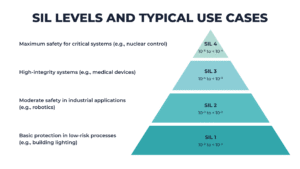
The four SIL levels exist on a scale of increasing risk reduction:
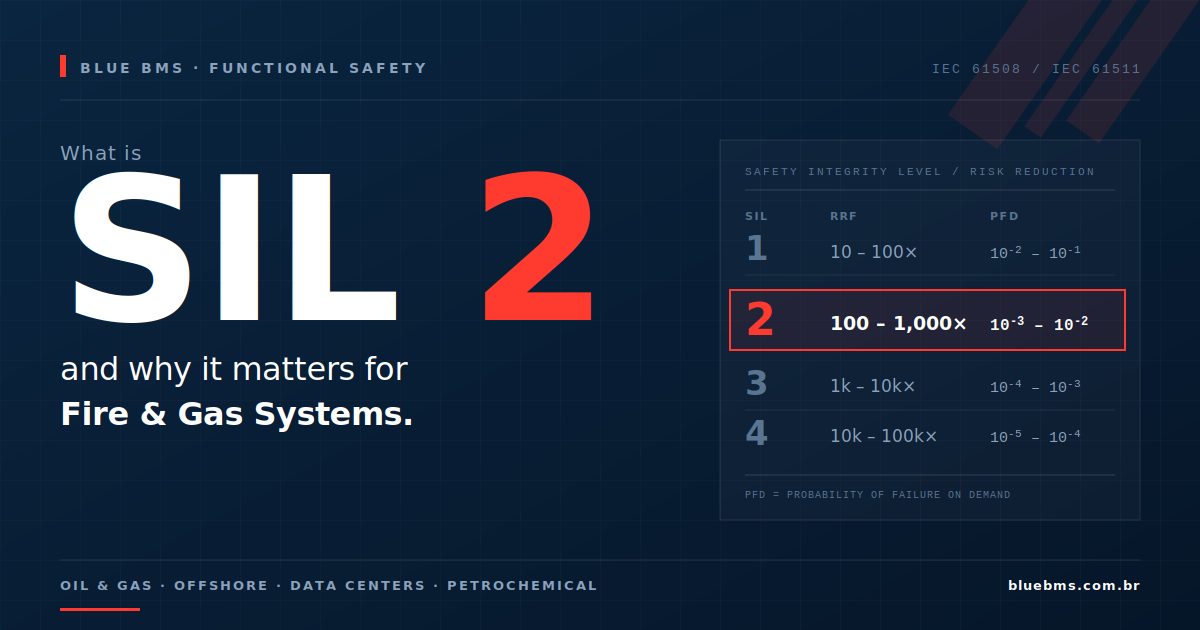
| SIL Level | Risk Reduction Factor (RRF) | PFD (low demand) | Typical Application |
|---|---|---|---|
| SIL 1 | 10 – 100 | 10⁻² – 10⁻¹ | Low-consequence process safety |
| SIL 2 | 100 – 1,000 | 10⁻³ – 10⁻² | Fire & gas, ESD in oil & gas, offshore, data centers |
| SIL 3 | 1,000 – 10,000 | 10⁻⁴ – 10⁻³ | High-consequence chemical, nuclear support |
| SIL 4 | 10,000 – 100,000 | 10⁻⁵ – 10⁻⁴ | Rare; nuclear, rail signaling |
For a SIL 2 fire and gas system, the average Probability of Failure on Demand (PFDavg) must remain below 0.01 — meaning that, on average, the protective function will fail to act no more than once every 100 times it is required. In addition, the Safe Failure Fraction (SFF) must exceed 90%, ensuring that fewer than 10% of failures are dangerous and undetectable.
Why SIL 2 matters for fire and gas systems
A fire and gas detection system is, by definition, a low-demand safety function: it sits silent for years and must perform flawlessly the one time it is needed. SIL 2 matters because it converts that abstract expectation — “it must work when it counts” — into measurable, auditable, third-party-certified engineering criteria.
For operators in oil & gas, offshore platforms, refineries, petrochemical units, LNG terminals, and tier-III/IV data centers, SIL 2 is what separates a generic detection panel from a safety-certified protection layer. Specifically:
- Regulatory and contractual compliance. Most tender specifications in upstream and downstream oil & gas, offshore and petrochemical projects explicitly require SIL 2-certified F&G for hydrocarbon detection, flame detection and audible/visible alarms. Operators that fail to meet this baseline are not technically non-compliant — they are simply not eligible to bid.
- Insurance and liability. Compliance with IEC 61508 / IEC 61511 is recognized as state-of-the-art engineering practice. In the absence of more specific local regulation, these standards are enforceable in court, making SIL certification a key piece of evidence in any post-incident investigation.
- Asset protection and uptime. In a data center, an undetected gas leak in a battery room or an unaddressed fire in a UPS gallery means hours — sometimes days — of downtime. SIL 2 reduces the probability of that failure by a factor of 100 to 1,000.
- People safety. The non-negotiable one. SIL 2 fire and gas systems exist so that workers in a hazardous area get the warning, the suppression and the shutdown they need before a hazard becomes a fatality.
How SIL 2 is calculated: PFD, SFF and HFT
Achieving a SIL 2 rating for a fire and gas system requires meeting three concurrent requirements defined by IEC 61508:
1. Probability of Failure on Demand (PFD)
The full safety loop — sensor (PFDSE) + logic solver (PFDLS) + final element (PFDFE) — must add up to a PFDavg between 10⁻³ and 10⁻². Every component contributes to the budget. A SIL 2-suitable detector paired with a non-certified panel does not produce a SIL 2 loop.
2. Safe Failure Fraction (SFF)
SFF measures what proportion of failures are either safe or detectable. For SIL 2 with a Hardware Fault Tolerance (HFT) of 0, complex (Type B) subsystems — programmable logic controllers, microprocessor-based detectors — require an SFF of at least 90%. Simple (Type A) subsystems require at least 60%.
3. Hardware Fault Tolerance (HFT) and Architectural Constraints
HFT defines how many component failures the system can tolerate without losing the safety function. SIL 2 typically requires HFT ≥ 1 for Type B subsystems, often implemented as 1oo2 (one-out-of-two) or 2oo3 (two-out-of-three) voting architectures in critical F&G zones.
4. Systematic Capability and Proof Testing
Beyond hardware math, SIL 2 demands a disciplined development lifecycle — requirements traceability, FMEA (Failure Mode and Effects Analysis), validation, and a defined proof test interval. Skipping proof tests in the field invalidates the SIL rating, regardless of what the datasheet says.
SIL 2 vs SIL 3 in fire and gas: which one do you actually need?
A common — and expensive — misconception is that “higher SIL is always better.” It is not. The required SIL is the output of a risk assessment (typically a HAZOP plus a LOPA — Layers of Protection Analysis), not a marketing preference.
- SIL 2 is appropriate for the vast majority of fire and gas applications: flame detection in process areas, hydrocarbon gas detection (combustible and toxic), F&G control panels, audible/visible warning devices, and deluge or clean-agent suppression release.
- SIL 3 is reserved for scenarios where a single failure could trigger a multi-fatality event or catastrophic asset loss — typically Emergency Shutdown (ESD) functions on high-pressure hydrocarbon inventories, not the F&G detection layer itself.
Over-specifying SIL 3 where SIL 2 is sufficient adds significant cost, hardware redundancy, and proof-test burden — with no measurable safety benefit. A properly executed LOPA is the right tool to settle the question.
What to look for in a SIL 2 fire and gas system
When specifying or procuring a SIL 2 fire and gas system, the following criteria should be non-negotiable:
- Third-party certification by an accredited body — such as TÜV SÜD, TÜV Nord, TÜV Rheinland, exida, FM Approvals, or SIRA. A manufacturer self-declaration is not equivalent.
- A Safety Analysis Report (SAR) for every device in the loop, with documented PFD, SFF and HFT values.
- End-to-end certified architecture — sensors, logic solvers, alarm devices and final elements must all be SIL 2-suitable, with proven compatibility.
- Compliance with sector-specific standards — for gas detection equipment, EN 50402 complements IEC 61508; for marine and offshore, IMO and DNV requirements apply.
- Documented proof-test procedures with intervals consistent with the PFD calculation.
- Lifecycle support — SIL is not a one-time stamp; it must be maintained through operations, maintenance, modifications and decommissioning, as required by IEC 61511’s safety lifecycle.
SIL 2 fire and gas systems in practice: industries that depend on them
SIL 2 fire and gas systems are the operational baseline for:
- Oil & gas (upstream, midstream, downstream) — wellheads, separators, compressors, storage terminals and refining units.
- Offshore platforms and FPSOs — where evacuation is complex and a single F&G failure can cascade rapidly.
- Petrochemical and chemical processing — units handling flammable, toxic or reactive inventories.
- LNG terminals and gas processing plants — methane and refrigerant leak detection.
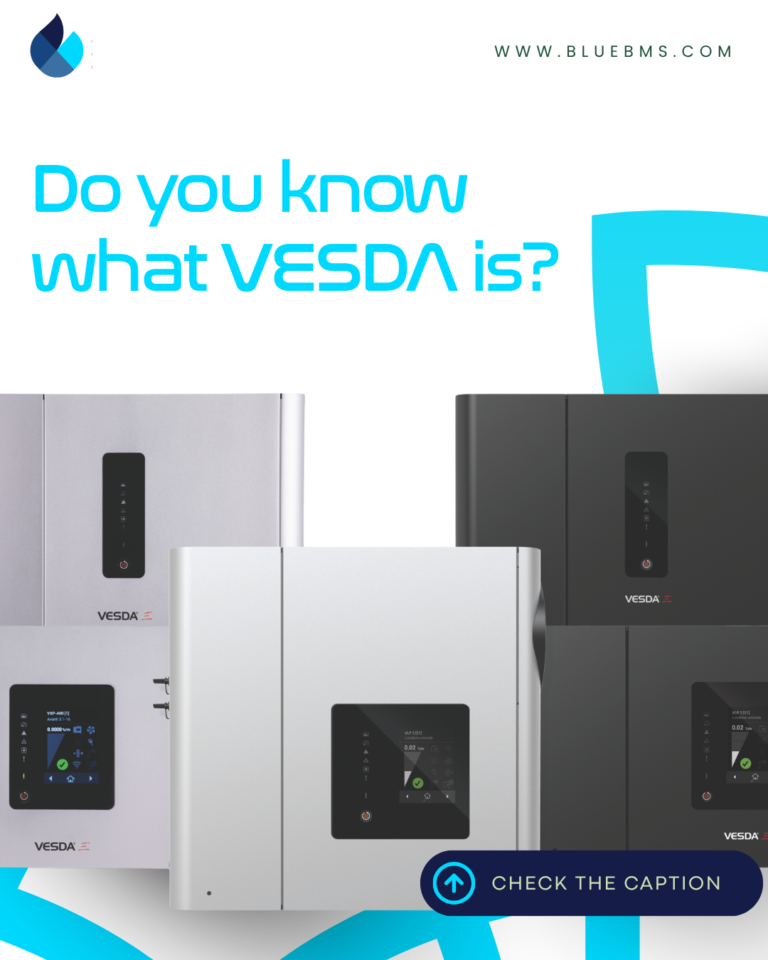
- Mission-critical data centers — early warning smoke detection (VESDA / aspirating systems), clean-agent suppression release and battery-room hydrogen detection.
- Power generation — gas turbines, transformer fire protection and hydrogen-cooled generators.
In each of these environments, the question is rarely “do we need fire and gas detection?” The real question is “is our fire and gas detection certified to perform when it has to?” SIL 2 is how that question gets answered with evidence.
Frequently Asked Questions
What does SIL 2 mean in fire and gas systems?
SIL 2 means a fire and gas safety function is certified under IEC 61508 to reduce risk by a factor of 100 to 1,000, with an average probability of failure on demand (PFDavg) between 10⁻³ and 10⁻². It is the standard reliability benchmark for fire and gas detection in oil & gas, offshore, petrochemical and data center facilities.
Is SIL 2 a device rating or a system rating?
Neither — strictly speaking, SIL applies to a Safety Instrumented Function (SIF), which is an end-to-end loop of sensor + logic solver + final element. Individual devices can only be SIL 2-suitable; they earn the SIL rating only when integrated into a properly designed and certified loop.
What is the difference between SIL 2 and SIL 3?
SIL 3 provides 10× more risk reduction than SIL 2 (PFD between 10⁻⁴ and 10⁻³). SIL 3 is typically required for Emergency Shutdown (ESD) functions on high-consequence hazards, while SIL 2 is the standard for fire and gas detection in most industrial applications.
Who certifies SIL 2 fire and gas systems?
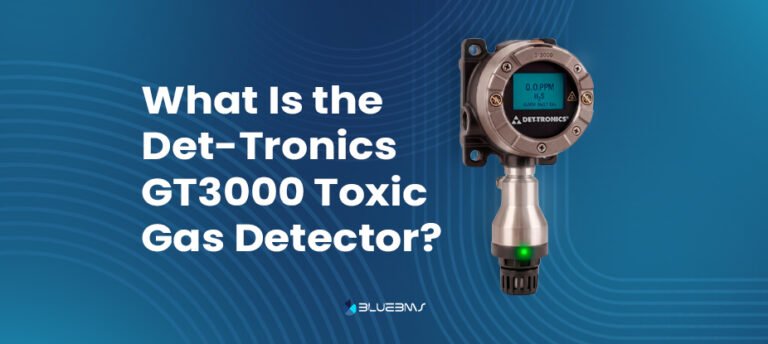
IIndependent, accredited third parties — TÜV Nord, TÜV SÜD, TÜV Rheinland, exida, FM Approvals and SIRA are among the most widely recognized certification bodies for IEC 61508 compliance. Many of the manufacturers Blue BMS works with — including Autronica, Det-Tronics and Honeywell Analytics — carry SIL 2 certification across their flame and gas detection portfolios.
Does SIL 2 expire?
The certification itself does not, but SIL compliance must be maintained throughout the operational lifecycle: documented proof tests at the prescribed interval, change management on every modification, and revalidation after major plant changes. IEC 61511 codifies these lifecycle obligations.
Is SIL 2 mandatory for fire and gas systems?
There is no global mandate, but it is contractually mandatory in the vast majority of oil & gas, offshore, petrochemical and mission-critical data center specifications. In practice, a non-SIL-rated F&G system rarely qualifies for tender in these sectors.
Key takeaways
- SIL 2 fire and gas systems reduce risk by a factor of 100 to 1,000 under IEC 61508.
- The PFDavg of a SIL 2 loop must remain below 0.01, with Safe Failure Fraction above 90% for complex subsystems.
- SIL applies to the complete safety function, not to individual devices.
- The right SIL level is determined by a structured risk assessment (HAZOP + LOPA), not by marketing.
- Third-party certification (TÜV, exida, FM, SIRA) and a documented Safety Analysis Report are non-negotiable.
- SIL is a lifecycle commitment — proof testing, change management and revalidation are part of the rating.
Specifying or auditing a SIL 2 fire and gas system?
Blue BMS designs and integrates SIL 2-certified fire and gas systems for industrial and mission-critical environments — oil & gas, offshore, data centers, petrochemical and power generation. From HAZOP/LOPA support to commissioning and lifecycle maintenance.