NFPA 72 vs EN 54: Which Fire Alarm Standard Applies to Your Project?
You are about to specify a fire alarm system. The project scope is defined. The equipment list is almost ready.
Then someone asks: “Which standard are we following — NFPA 72 or EN 54?”
And suddenly, a question that looks simple has the power to delay commissioning, invalidate insurance, and force a complete system redesign.
I see this happen on multinational projects, offshore platforms, and data center builds more often than it should. Engineers and project managers pick a standard based on familiarity, not jurisdiction. By the time the AHJ weighs in, it is late.
In this article, we will give you a direct, practical comparison of NFPA 72 and EN 54, the two dominant global fire alarm frameworks, so you can make the right call from day one.
Quick Summary
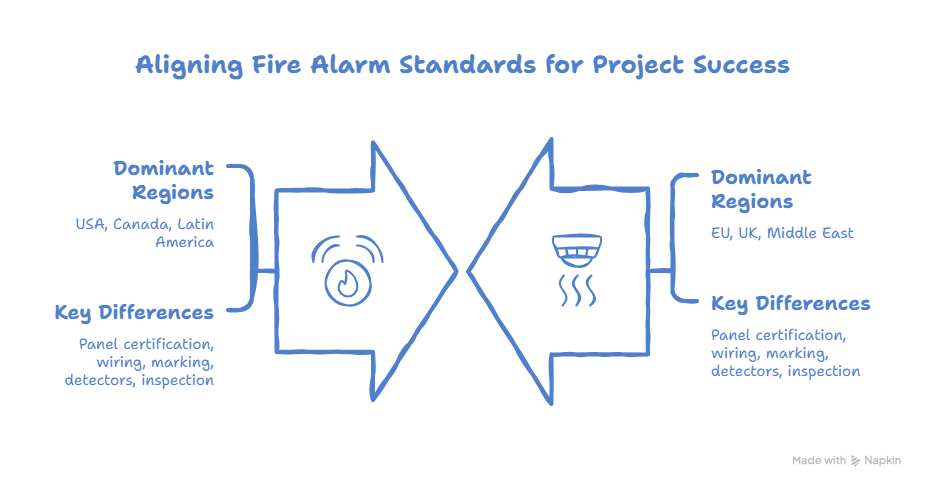
- NFPA 72 is the American fire alarm code, dominant in the USA, Canada, and Latin America.
- EN 54 is the European standard series, mandatory across the EU, UK, and widely used in the Middle East.
- The most important factor in standard selection is the Authority Having Jurisdiction (AHJ).
- The standards differ in panel certification, wiring topology, product marking, detector criteria, and inspection frequency.
- Mixing EN 54-certified and UL-listed equipment in the same system is generally not permitted.
What is NFPA 72?
NFPA 72, the National Fire Alarm and Signaling Code, is published by the National Fire Protection Association in the United States and updated every three years.
It governs the full lifecycle of fire alarm systems, including design, installation, testing, inspection, and maintenance.
NFPA 72 is the mandatory standard in the United States and is widely adopted across Canada and Latin America. If you are building in the Americas, this is usually your default framework.
Control units must be UL 864 listed. Detectors must carry UL Listings specific to the device type, such as UL 268 for smoke detectors. Documentation requirements center on the Record of Completion in Chapter 7.
What is EN 54?
EN 54 is not a single document. It is a series of standards published by the European Committee for Standardization, covering more than 30 individual parts.
- EN 54-2: Control and indicating equipment
- EN 54-7: Point-type smoke detectors
- EN 54-5: Heat detectors
- EN 54-22: Linear heat detectors
- EN 54-14: Planning, design, installation, commissioning, use, and maintenance guidelines
Compliance with EN 54 is mandatory across the European Union under the Construction Products Regulation. Products must carry the CE mark for sale and installation in EU member states. In the UK, BS EN 54 remains relevant, with UKCA marking replacing CE marking for many applications.
What is the Difference Between NFPA 72 vs EN 54?
This is where many specifications go wrong. The standards are not just geographic variants of the same concept. They differ in architecture, certification, wiring, inspection, and documentation.
| Criteria | NFPA 72 | EN 54 |
|---|---|---|
| Publishing body | NFPA, USA | CEN, Europe |
| Standard structure | Single code with multiple chapters | Series of individual parts |
| Panel requirements | UL 864 listed control units | EN 54-2 certified control and indicating equipment |
| Wiring topology | Class A, Style 6/7; Class B, Style 4 | Type A, Type B, Type C |
| Detector certification | UL Listed, such as UL 268 | EN 54 part-specific certification |
| Commissioning record | Record of Completion | Cause-and-effect matrix and commissioning certificate |
| Inspection frequency | Annual, with quarterly checks for select devices | Typically semi-annual, depending on local code |
| Product marking | UL Listing mark | CE mark or UKCA mark |
Critical point: these differences are not cosmetic. A panel certified to EN 54-2 was tested to different criteria than a UL 864 listed panel. A detector with CE marking was not evaluated against UL 268.
This is why mixing equipment from both standards in a single system is generally not permitted.
NFPA 72 vs EN 54 | Where Does Each Standard Apply?
The single most important factor in choosing between NFPA 72 and EN 54 is the project location and the Authority Having Jurisdiction.
| Region | Applicable Standard | Notes |
|---|---|---|
| United States | NFPA 72 | Enforced by local AHJ and state fire marshals |
| Canada | NFPA 72 / CAN/ULC | Provinces may adopt ULC or NFPA variants |
| Latin America | NFPA 72, often | Brazil, Colombia, and Mexico commonly reference NFPA 72 |
| European Union | EN 54 | Required under CPR with CE marking |
| United Kingdom | EN 54 / BS 5839 | UKCA marking applies post-Brexit |
| Middle East | EN 54 or NFPA 72 | Check local civil defense approval |
| Australia / New Zealand | AS 7240 | Based on ISO 7240 |
For multinational projects: offshore platforms, data centers, and cross-border facilities must confirm requirements with each jurisdiction’s AHJ before equipment is specified.
Which Standard Applies by Industry?
Oil & Gas and Offshore
Offshore platforms in the North Sea are commonly subject to EN 54 and IEC 61508 for functional safety. Gulf of Mexico projects typically follow NFPA 72 combined with API RP 505.
FPSOs and floating production units also fall under classification society rules, such as DNV, Lloyd’s Register, or Bureau Veritas, depending on contract specification, flag state, and operating region.
Data Centers
European data centers must use EN 54-certified detection and suppression equipment. US-based facilities generally follow NFPA 72 alongside NFPA 75 and NFPA 76.
For global operators, a single fire alarm bill of materials rarely works across regions. Equipment specifications must be adapted to the jurisdiction.
Commercial Buildings
In the EU, commercial buildings require EN 54-certified panels, detectors, and CE-marked devices. In the US, local fire marshals and building departments enforce NFPA 72, with UL-listed equipment as the default expectation.
How to Choose the Right Standard: 5 Steps
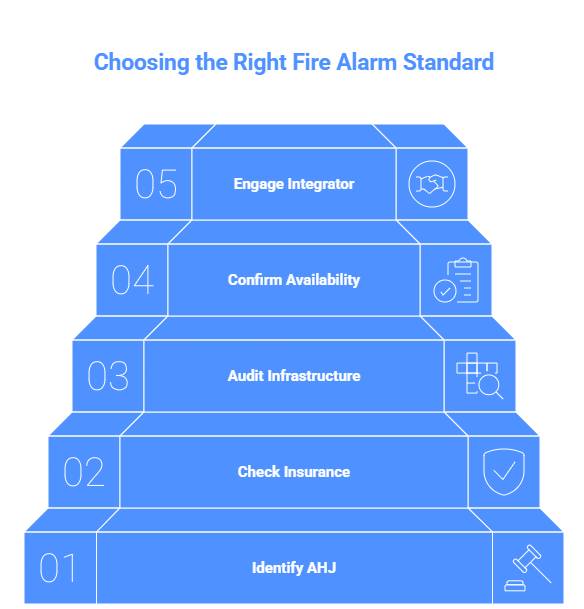
1. Identify the AHJ First
The Authority Having Jurisdiction determines which standard is legally enforceable. Get the AHJ determination in writing before finalizing the specification.
2. Check Insurance Requirements
Some insurers require NFPA 72 or EN 54 compliance as a condition of coverage, independent of local law.
3. Audit the Existing Infrastructure
If the project integrates with an existing fire alarm system, new equipment must match the certified standard of the installed base.
4. Confirm Product Availability
Not all manufacturers produce dual-listed equipment. Confirm availability before tender close, especially for specialty devices.
5. Engage a Certified System Integrator Early
Both standards require qualified commissioning, documentation, and as-built records. Early integrator involvement prevents expensive redesigns later.
Quick reference:
- Project in the Americas? Default to NFPA 72 unless the AHJ specifies otherwise.
- Project in Europe, UK, or Middle East? Default to EN 54 with CE or UKCA marking.
- Multinational or offshore project? Engage the AHJ early and document all approved deviations.
Real-World Impact: What Happens When You Get It Wrong
Consider a data center project in Frankfurt specified by a US-based engineering firm.
The engineer draws on NFPA 72, the standard they know. The equipment list is UL-listed. The panel is UL 864. The design is solid by American standards.
At commissioning, the German building authority rejects the system. None of the installed equipment carries CE marking. The entire detection layer needs to be replaced with EN 54-2 and EN 54-7 certified equivalents.
Result: a 14-week delay, full equipment replacement, and a contract dispute over who bears the cost.
Need Help Specifying the Right Fire Alarm System?
Blue BMS supplies EN 54-certified and NFPA 72-compatible fire detection equipment for oil & gas, offshore, data center, and commercial projects worldwide.
Our technical team can review your project location, AHJ requirements, and existing infrastructure to confirm the right specification from the outset.
Frequently Asked Questions
What is the difference between NFPA 72 and EN 54?
NFPA 72 is the American fire alarm code published by NFPA. EN 54 is the European fire detection and alarm standard series published by CEN. They differ in certification, architecture, product marking, wiring, and inspection requirements.
Can NFPA 72 and EN 54 equipment be used in the same system?
Generally, no. Each standard has specific performance tests, certification requirements, and documentation rules. Mixing equipment may void compliance and cause AHJ rejection.
Which fire alarm standard applies to offshore oil and gas projects?
It depends on the flag state, coastal jurisdiction, classification society, and contract specification. North Sea projects often follow EN 54, while Gulf of Mexico projects commonly follow NFPA 72.
What are the inspection requirements under NFPA 72 versus EN 54?
NFPA 72 generally requires annual inspection and testing, with additional checks for selected devices. EN 54 projects commonly follow local rules or BS 5839-1 guidance, often requiring semi-annual inspections.
Does EN 54 apply in the Middle East?
In many GCC countries, both EN 54 and NFPA 72 may be referenced. Local civil defense approval should always be confirmed before specifying equipment.