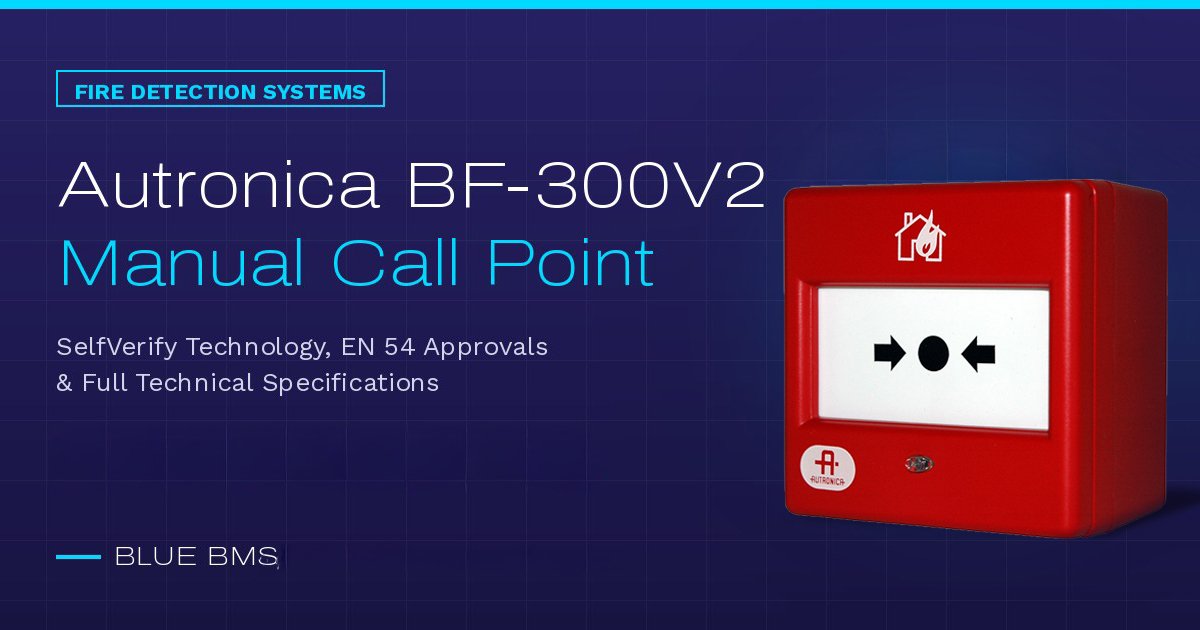
The Autronica BF-300V2 manual call point is an addressable, indoor fire alarm call point with the SelfVerify self-testing function, a built-in short-circuit isolator and LED indication. Approved to EN 54-11 and EN 54-17, it is designed for Autronica’s interactive fire detection systems — AutroSafe and Autroprime — and automatically tests itself every 24 hours.
In interactive fire detection, manual call points remain the fastest human-triggered layer of protection: when a person identifies a fire before a detector does, a single press must reliably initiate the alarm sequence. This article breaks down the BF-300V2’s architecture, the SelfVerify function, complete technical specifications, versions, accessories and typical applications across industrial and maritime environments.
Key Takeaways
- The BF-300V2 responds in a maximum of 3 seconds and is automatically self-tested once every 24 hours via SelfVerify.
- Each unit integrates a short-circuit isolator (EN 54-17) and supports automatic addressing on the detection loop.
- Approved to EN 54-11 Type A for indoor applications and designed to meet major maritime classification society requirements.
- Operates at 16–26 VDC with just 0.3 mA standby consumption, in a compact 87 × 87 mm housing.
What Is the Autronica BF-300V2 Manual Call Point?
The BF-300V2 is the standard indoor version in Autronica’s 300 series of manual call points (part number 116-BF-300V2). It is a resettable, press-to-activate device: the operator presses the white plastic element to trigger the alarm, and the unit is reset with a dedicated test key — no glass replacement required in day-to-day operation. An optional break-glass element is available for facilities that require it, resettable by mounting a new glass element.
Unlike conventional call points that act as simple switches, the BF-300V2 is an intelligent loop device. It communicates with the fire alarm control panel over the detection loop, is automatically assigned an address during commissioning, and continuously reports its own health status. A built-in LED provides local alarm indication, and a maximum response time of 3 seconds ensures the panel registers activation almost instantly.
How Does the SelfVerify Function Work?
SelfVerify is Autronica’s automatic self-testing technology: every device equipped with the function — including the BF-300V2 — verifies its own ability to initiate an alarm once every 24 hours, without manual intervention. The result is the highest grade of reliability with the lowest degree of manual testing across the installation’s lifetime.
For facility managers and system integrators, this translates into three measurable operational benefits:
- Reduced maintenance cost: routine functional testing of each call point is performed by the system itself, cutting technician hours dedicated to periodic manual verification.
- Continuous compliance evidence: the panel logs each self-test, providing an auditable record that every call point on the loop is operational — valuable during inspections and classification surveys.
- Early fault detection: a unit that fails its daily self-test is flagged immediately, instead of remaining silently defective until the next manual test cycle.
Physical testing remains possible at any time using the special test key, which activates the call point exactly as a real emergency press would — and resets it afterwards.
Key Features of the BF-300V2
- Maximum 3-second response time from activation to alarm initiation
- SelfVerify function — automatic self-test every 24 hours
- Built-in short-circuit isolator in every call point (EN 54-17)
- Automatic addressing on the detection loop — no manual DIP-switch configuration
- Built-in LED indicator for local alarm status
- Testable with a dedicated test key, resettable without consumables
- Designed for maritime classification — meets the requirements of the major classification societies
- EN 54-11 and EN 54-17 approved for indoor applications
The integrated short-circuit isolator deserves emphasis: in loop-based fire detection architecture, a single short circuit can disable an entire segment of devices. Because every BF-300V2 isolates faults at the device level, a cable failure is contained between two adjacent units — the rest of the loop keeps operating. This is a decisive design factor in high-consequence environments such as offshore platforms, data centers and petrochemical facilities.
BF-300V2 Technical Specifications
| Parameter | Value |
|---|---|
| Part number | 116-BF-300V2 |
| Voltage | 16 – 26 VDC |
| Current consumption (standby) | 0.3 mA |
| Current consumption (alarm, LED) | 6 mA |
| Maximum current on detection loop | 200 mA (standard version) |
| Degree of protection | IP44D with cover / IP42D without cover |
| Working temperature | −25 °C to +70 °C |
| Storage temperature | −55 °C to +70 °C |
| Humidity (non-condensing) | Max. 95% RH |
| Material | ABS FR/PC (flame retardant) |
| Colour | Red |
| Weight | 160 g |
| Dimensions (front plate) | 87 × 87 mm, 53 mm depth |
| Cable wire | Maximum 2.5 mm² |
| CPD certificate | 0333-CPD-075247 |
| Approvals | EN 54-11 Type A, EN 54-17 (indoor) |
| Service policy | Replace if faulty |
Source: Autronica Fire and Security AS, BF-300V2 Product Datasheet (Doc-1000318-3, 2026).
Loop Wiring and Connections
The BF-300V2 connects in-line on the detection loop with four active terminals: +In, −In, +Out and −Out. Because the short-circuit isolator sits inside each device, the in/out wiring topology allows the loop to be sectioned automatically around a fault. Cabling accepts conductors up to 2.5 mm², and the standard version supports a maximum of 200 mA on the detection loop — a parameter to factor into loop-load calculations when combining call points with detectors, sounders and I/O modules on the same circuit.
Versions, Accessories and Spares
The 300 series covers two SelfVerify-equipped variants:
- BF-300V2 — standard indoor manual call point with SelfVerify (this article)
- BF-510WP-H — weatherproof, high-current version for outdoor and harsh-environment installations (separate datasheet)
| Part Number | Item | Type |
|---|---|---|
| 116-4860-011.0100 | Polycarbonate cover (raises protection to IP44D) | Accessory |
| 116-CXBZ | Bezel for flush mounting | Accessory |
| 116-BFG-3 | Glass element (break-glass option) | Accessory |
| 116-4860-011.0025 | Spare call point | Spare |
Additional accessories in the Autronica ecosystem include lift flaps, tamper-proof covers, robust mounting brackets and the dedicated reset/test key shared with the BF-510WP-H.
Installation Requirements and Placement
The BF-300V2 must be installed according to local regulations, which normally means positioning along escape routes, landings and exits — the points where occupants naturally pass during an evacuation. Its mounting base uses a 36 mm hole pattern with a compact 53 mm total depth (20 mm surface projection with flush accessories), fitting standard back boxes across commercial and industrial construction.
For environments with wash-down routines, dust or incidental splashing, specifying the optional polycarbonate cover raises ingress protection from IP42D to IP44D while also reducing accidental activation.
Where the BF-300V2 Is Applied
As part of the AutroSafe and Autroprime interactive platforms, the BF-300V2 is deployed across sectors where verified reliability is a contractual and regulatory requirement:
- Maritime and offshore: designed to meet the requirements of the major classification societies, with a wide operating range of −25 °C to +70 °C.
- Oil & gas and petrochemical facilities: indoor control rooms, accommodation modules and technical buildings where loop integrity and self-testing reduce operational risk — a growing requirement across the European oil & gas market.
- Data centers: integration with interactive detection ensures every manual initiation point is verified daily without interrupting operations. See our guide to fire protection for data centers.
- Commercial and industrial buildings: EN 54-11/54-17 compliance for European-regulated installations. For a comparison of the two main regulatory frameworks, read NFPA 72 vs. EN 54.
Frequently Asked Questions
What is the difference between the BF-300V2 and a conventional manual call point?
A conventional call point is a passive switch on a zone circuit. The BF-300V2 is an addressable loop device with automatic addressing, a built-in short-circuit isolator and the SelfVerify function, which self-tests the unit’s ability to initiate an alarm every 24 hours and reports its status to the control panel.
Is the BF-300V2 suitable for outdoor installation?
No. The BF-300V2 is approved to EN 54-11 and EN 54-17 for indoor applications only. For outdoor or harsh environments, Autronica offers the BF-510WP-H, a weatherproof high-current version with SelfVerify.
How is the BF-300V2 reset after activation?
The standard white plastic element is resettable with a dedicated test key — no parts are consumed. If the optional break-glass element is installed, resetting requires mounting a new glass element (part 116-BFG-3).
Which fire alarm systems is the BF-300V2 compatible with?
The BF-300V2 is designed for Autronica’s interactive fire detection systems, including the AutroSafe and Autroprime platforms, communicating over the addressable detection loop.
Does SelfVerify eliminate manual testing entirely?
SelfVerify drastically reduces manual testing by performing an automatic functional self-test every 24 hours, but local regulations may still require periodic physical tests. These can be performed quickly with the special test key without damaging the unit.
Specify the BF-300V2 for Your Project
Blue BMS is a global distributor of Autronica fire detection systems for oil & gas, maritime, data center and industrial applications. Our engineering team supports loop design, product selection and international logistics.