What Is VESDA? Aspirating Smoke Detection Explained
Quick Answer for Specifiers
VESDA is a brand of aspirating smoke detection (ASD): a system that continuously draws air samples through a network of sampling pipes into a centralized, highly sensitive detection chamber, instead of waiting for smoke to reach a point detector. This active sampling method allows it to detect smoke at the incipient stage, often before it’s visible. Performance is governed by EN 54-20, which defines three sensitivity classes (A, B, and C) that must be matched to the airflow, contamination profile, and risk of the space being protected — not applied uniformly across every application.
What Is Aspirating Smoke Detection (ASD)?
Standard point-type and photoelectric smoke detectors are passive: they wait for smoke to drift to their location and accumulate enough density to trigger an alarm. In environments with high airflow, high ceilings, or air handling that dilutes smoke before it reaches the ceiling, that passive approach introduces delay.
Aspirating smoke detection works differently. A network of sampling pipes with strategically placed holes continuously draws air from the protected space into a centralized detection chamber, where even very low concentrations of smoke particulate can be identified. Because the system is actively sampling rather than waiting, it can flag combustion products at the incipient stage of a fire — the earliest phase, often before there’s enough smoke to see or smell.
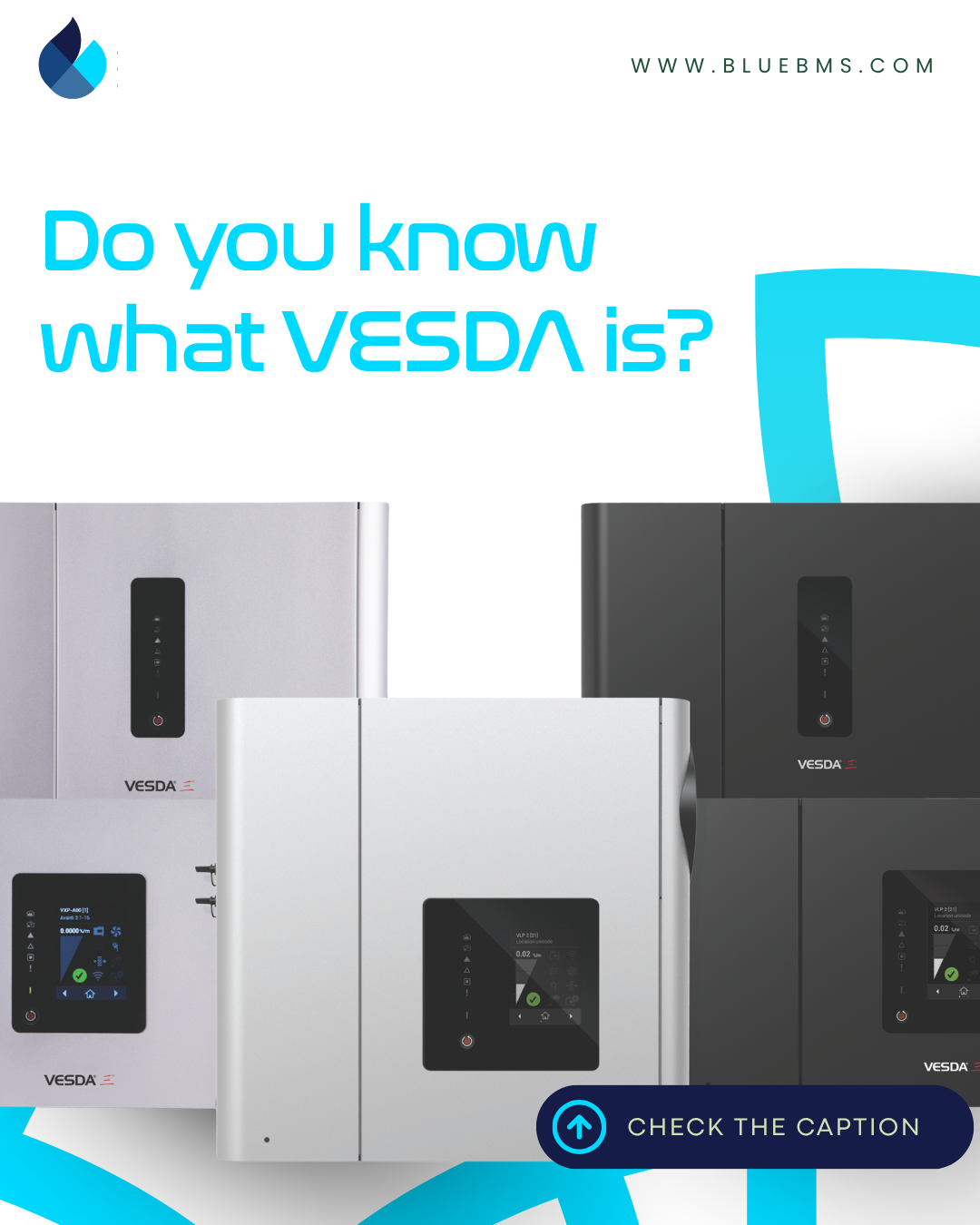
VESDA (originally an acronym for Very Early Smoke Detection Apparatus), now part of the Honeywell/Xtralis portfolio, is the most widely specified ASD product line globally, but VESDA is a brand within the broader ASD category — not a synonym for the technology itself.
Why Specifiers Choose ASD Over Point Detection
The case for ASD is strongest where one or more of the following conditions apply:
- High airflow or high air-change environments (data halls, cleanrooms) where smoke dilutes before reaching a ceiling-mounted point detector
- High-value or mission-critical assets where even a short delay in detection has outsized consequence (server racks, telecom switch rooms, control rooms)
- Concealed or inaccessible spaces (below raised floors, above suspended ceilings, inside cable risers) where routine access for point-detector maintenance is difficult
- Aesthetic or environmental constraints where visible ceiling-mounted devices aren’t practical (heritage buildings, cleanrooms, museums)
ASD is not a universal upgrade over point detection. In lower-risk, normally ventilated spaces, a correctly specified point or beam detector meeting EN 54-7 performance is often the more proportionate and cost-effective choice.
EN 54-20: The Standard That Governs ASD Sensitivity
In Europe, ASD performance is governed by EN 54-20, which introduced a three-tier sensitivity classification specifically because “aspirating smoke detection” alone doesn’t say enough about how a system is configured for a given risk. The classes are:
| Class | Description | Typical Application |
|---|---|---|
| Class A | Very high sensitivity — detects extremely dilute smoke | Environmentally controlled areas with high airflow, such as air-conditioning ducts or cleanrooms, where smoke must be caught before it disperses |
| Class B | Enhanced sensitivity — early detection for valuable or vulnerable assets | Areas close to critical equipment, such as data center white space or electronic equipment cabinets |
| Class C | Normal sensitivity — general fire protection | Standard occupied spaces, giving at least the equivalent detection level of a conventional point-type smoke detector |
A critical point for specifiers: the class is a sensitivity requirement, not a performance guarantee on its own. A detector can be certified across all three classes, but selecting Class A for a space that doesn’t need it — without adjusting alarm thresholds and airflow compensation to match actual site conditions — is a common source of nuisance alarms and alarm fatigue, not because Class A is inherently prone to false alarms, but because sensitivity, threshold, and environment must be engineered together.
Where Specification Commonly Goes Wrong
Over-specifying without adjusting configuration. Assigning the same sensitivity class to every space “to be safe” — for example, giving a moderately clean server room the same Class A configuration as a semiconductor cleanroom — without recalibrating thresholds and alarm delays to the space’s actual contamination profile, is one of the most common ways ASD systems end up generating nuisance alarms that operators eventually start ignoring.
Under-specifying high-airflow spaces. Treating a high-airflow data hall or an area with a high rate of air changes per hour as a standard occupancy and defaulting to point detection can allow dilution effects to delay detection past the point where early warning still matters.
Treating pipe network design as an afterthought. EN 54-20 compliance is only part of the picture. Sampling-hole positioning, pipe run length, transport time (the time for a smoke sample to travel from the sampling point to the detection chamber), and airflow balancing all have to be calculated for the specific space, typically using pipe modeling software, not assumed from a generic layout.
Specification Checklist
A properly specified ASD system requires matching, together, not in isolation:
- Sensitivity class (A, B, or C) per EN 54-20, based on the consequence of a missed early-stage event in that space
- Airflow and air-change rate of the protected area
- Contamination and dust profile of the environment, to avoid nuisance alarms
- Pipe network design, including sampling-hole placement and transport time
- Alarm thresholds and multi-level alarm strategy, calibrated to the specific site, not left at default
Frequently Asked Questions
Is VESDA the same thing as aspirating smoke detection?
VESDA is a specific product line, currently part of the Honeywell/Xtralis portfolio, within the broader aspirating smoke detection (ASD) category. Other manufacturers produce ASD systems as well. In practice, “VESDA” is often used informally to refer to the technology as a whole, similar to how a well-known brand name can become shorthand for its product category.
Does ASD replace point-type smoke detectors?
Not universally. ASD is specified where early warning, high airflow, concealed spaces, or high-value assets justify the added sensitivity and system complexity. Many facilities use a combination of ASD in critical zones and point or beam detection elsewhere, based on a room-by-room risk assessment.
What does EN 54-20 Class A, B, or C actually determine?
The class defines the minimum sensitivity an aspirating detector must demonstrate against a set of standardized test fires. It does not, by itself, determine alarm behavior in the field — that also depends on how thresholds, delays, and airflow compensation are configured for the specific site.
Does a higher sensitivity class mean more false alarms?
Not inherently. Nuisance alarms are typically the result of a sensitivity class that doesn’t match the site’s contamination and airflow profile, combined with thresholds that weren’t adjusted for those conditions — not a direct consequence of choosing a higher class.
Need help specifying an ASD system for your facility?
Blue BMS supports fire and gas specifiers with VESDA and other aspirating smoke detection product selection, EN 54-20 class matching, and pipe network design considerations for data centers, oil & gas, and industrial environments.
This article is intended as a general specification reference. Always verify class selection, pipe network design, and alarm configuration against the current EN 54-20 standard and manufacturer engineering guidelines for the specific project.