
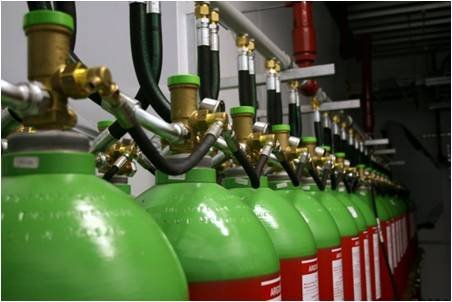
Gaseous Fire Suppression Systems: Technical Guide for Integrators
Designing and integrating gaseous fire suppression systems requires deep knowledge of standards, agent physics, hydraulic calculations, environmental integrity, and full integration with detection, alarm, and control systems.
This technical guide covers the critical engineering principles every professional fire protection integrator must master to deliver compliant, reliable, and high-performance gas suppression solutions.
Scope: suppression mechanisms, clean agents and inert gases, NFPA/ISO compliance, system sizing, enclosure integrity, piping design, applications, system integration, commissioning, and lifecycle maintenance.
Extinguishment Fundamentals
Gaseous fire suppression systems operate through three primary extinguishing mechanisms:
oxygen reduction (inertization), heat absorption (cooling), and chemical flame inhibition.
Most systems use a combination of these effects, which is why agent selection is not just a commercial decision — it is a physics and risk-engineering decision.
Engineering factors such as human occupancy, discharge time, enclosure integrity, and HVAC interaction define real system performance, not just theoretical design values.
Inert Gases, Clean Agents, and CO₂
Inert Gas Agents (IG-01, IG-55, IG-541)
Inert agents extinguish fire by reducing oxygen concentration from ~21% to approximately 12–15%.
Typical design concentrations range from 34% to 43% by volume.
Discharge time is generally 60–120 seconds, prioritizing life safety and controlled pressure dynamics.
Engineering characteristics: high-pressure storage (200–300 bar), low storage density, ambient discharge temperature, and zero residue.
High operating pressure requires robust piping systems and structural verification.
IG-541 (Inergen)
Composed of 52% nitrogen, 40% argon, and 8% CO₂.
The CO₂ component stimulates respiration, partially compensating oxygen reduction and improving human safety margins in occupied spaces.
Clean Agents (Halocarbon Systems)
Clean agents such as HFC-227ea (FM-200), FK-5-1-12 (Novec 1230), and HFC-125
suppress fire primarily through heat absorption and chemical reaction interruption, offering high volumetric efficiency.
HFC-227ea (FM-200)
Typical design concentration: 7–9% (Class A), 8.5–10% (Class B/C).
Storage pressure ~25 bar, commonly super-pressurized with nitrogen (~42 bar).
Discharge time: ≤10 seconds.
Human exposure limits must always be validated through NOAEL/LOAEL analysis.
FK-5-1-12 (Novec 1230)
Typical design concentration: 4.2–6%.
Low environmental impact profile and strong safety margins make it a preferred solution in ESG-driven projects and mission-critical infrastructure.
Carbon Dioxide (CO₂)
CO₂ systems operate in high-pressure or low-pressure configurations.
Flooding concentrations typically range from 34% (surface fires) to 50–75% (deep-seated fires).
Mandatory evacuation is required due to asphyxiation risk.
Codes and Standards
Compliance is mandatory in gaseous suppression engineering.
Core references include NFPA 2001 (clean agents), NFPA 12 (CO₂),
ISO 14520 (gaseous systems), and NFPA 72 for detection and release integration.
Local AHJ requirements, occupational safety regulations, environmental policies, and insurance standards must also be applied.
System Design and Calculations
Volume and Agent Quantity
Design begins with net enclosure volume calculation:
Vnet = Vgross − Vobstructions.
Agent mass or volume is calculated using agent-specific formulas considering temperature, pressure, and design concentration.
Safety Factors and Altitude Correction
Engineering practice requires safety margins (typically 10–20%).
Altitude correction is mandatory in high-elevation projects and must follow manufacturer and standard correction tables.
Enclosure Integrity
Retention time (commonly ≥10 minutes) is critical.
Door fan testing validates enclosure leakage and determines real system performance.
Unsealed penetrations, HVAC leakage, raised floors, and ceiling voids are the primary failure points in real installations.
Piping and Nozzle Design
Hydraulic calculations ensure uniform distribution, correct discharge time, and pressure control.
Improper pipe sizing leads to vibration, noise, uneven discharge, and system failure under real conditions.
Application Engineering
Data Centers
Clean agents dominate due to fast discharge and zero residue.
HVAC integration, leakage control, and early detection (aspirating systems) define real reliability.
Hospitals
Human occupancy risk defines agent selection.
MRI rooms require non-magnetic materials and remote placement of cylinders.
Electrical rooms balance CO₂ cost efficiency with life-safety risk controls.
Archives and Museums
Zero-residue suppression and ultra-early detection dominate design criteria.
Industrial Control Rooms
Integration with ESD systems, pressure control, and HVAC isolation are mandatory design elements.
Battery Rooms
Electrical fire risk combined with hydrogen generation requires a coordinated ventilation, detection, and suppression strategy.
System Integration Architecture
Typical architecture includes a dedicated releasing control panel integrated with the fire alarm system.
Cross-zone logic is standard to prevent accidental discharge.
System performance depends more on control logic than hardware quality.
Integration includes HVAC shutdown, damper closure, door control, process shutdown, and emergency notification systems.
Agent Selection Matrix
- Human safety
- Environmental impact (ESG)
- Volumetric efficiency
- Discharge speed
- Total cost of ownership
- Operational recovery
There is no universal “best agent” — only the correct agent for each risk profile.
Commissioning and Testing
Professional commissioning includes enclosure integrity testing, functional logic testing, and interlock verification.
sequence simulation, and full documentation delivery.
Documentation includes as-built drawings, calculations, test reports, cause-and-effect matrices, and operational procedures.
Inspection and Maintenance
Gaseous fire suppression systems require structured inspection cycles: visual inspections, functional tests, pressure verification,
logic testing, and enclosure integrity reassessment after layout changes.
Common Challenges
Gaseous fire suppression systems’ primary risks include enclosure leakage, insufficient cylinder space, false discharges, regulatory compliance, and environmental regulations.
Engineering solutions require proper design governance and lifecycle management.
Emerging Technologies
Trends include in-rack suppression, IoT monitoring, predictive maintenance, hybrid suppression systems,
digital twins, and ESG-driven agent migration.
Conclusion
Gaseous fire suppression systems demand engineering discipline, not just installation capability.
For integrators, mastery of standards, calculations, integration logic, and commissioning methodology is a competitive advantage.
As infrastructure becomes more complex, technical competence in gas suppression becomes a strategic market differentiator.
Need technical support?
Agent selection, system design, integration architecture, and commissioning support can define project success.
Work with certified specialists and compliance-driven engineering partners.
FAQ
What are gaseous fire suppression systems?
They are fire suppression systems that use gases or clean agents instead of water to extinguish fire through oxygen reduction, heat absorption, or chemical inhibition.
What is the main standard for clean agent systems?
NFPA 2001 is the primary global reference, supported by ISO 14520 and local fire codes.
Why is enclosure integrity critical?
Because gas concentration must be maintained long enough to suppress combustion, leakage directly reduces system effectiveness.
Are gaseous systems safe for occupied spaces?
Some agents are suitable for occupied spaces when designed within NOAEL/LOAEL limits. CO₂ systems require evacuation before discharge.
Resources:
Fire brand: https://firebrandsa.co.za/gaseous-fire-suppression/
ORR protections: https://www.orrprotection.com/suppression/inergen