Advanced Smoke Detection Systems: Integrating Beam Detectors for Critical Fire Safety via BMS
The safety and resilience of modern commercial facilities hinge on sophisticated Building Management Systems (BMS) that unify mechanical, electrical, and safety infrastructure. Within this integrated framework, fire detection devices, such as specialized beam detectors, cease to be standalone alarms; they become critical data points that drive complex, coordinated disaster responses.
This technical article explores the vital role of advanced smoke detection systems, like beam detectors, in maintaining facility integrity and how their integration into a BMS ensures rapid, automated emergency protocols.
Table of Contents
- The Critical Role of Fire Safety Sensors in the BMS Architecture
- BMS Integration: Automated Fire Response Protocols
- Beam Detection Systems: Advanced Monitoring for Large Spaces
- Technical Interfacing: Connecting Detectors to DDC Controllers
- Choosing Advanced Detection Solutions (Product Link)
- Technical Reference Table
- Frequently Asked Questions (FAQ)
1. The Critical Role of Fire Safety Sensors in the BMS Architecture
A Building Management System (BMS), also known as a Building Automation System (BAS), is designed for the automatic centralized control of a building’s interrelated mechanical and electrical systems. While improving occupant comfort and operational efficiency are key objectives, increasing security is equally paramount.
Fire alarm systems are a critical part of this security mandate and are sometimes linked to the BMS for monitoring. Sensors are fundamental hardware components of a BMS, continuously collecting data on various parameters, including temperature, humidity, and smoke presence. This data is processed by the BMS software to identify anomalies and trigger corrective actions via actuators.
For example, specialized smoke detectors are installed in critical areas like AC ducts. Their operation is essential to safety, particularly during the installation phase of a new BMS, where wiring for the detector connection must be carried out as per approved shop drawings.
2. BMS Integration: Automated Fire Response Protocols
The greatest benefit of integrating specialized detection systems into the BMS is the ability to orchestrate a complex, building-wide emergency response. The goal is to contain the hazard and prevent harm and structural damage.
When a fire or smoke condition is detected by a device (such as a beam detector) and relayed through the fire alarm panel, the BMS initiates specific actions:
- HVAC Control: The fire alarm panel could close the ventilation dampers in the ventilation system to prevent smoke from spreading. It must also shut down air handlers and start smoke evacuation fans. Control wiring for HVAC equipment, like fans and air handlers, must be coordinated with fire safety requirements.
- Access and Egress: The system may manage access control and security devices. In an emergency, the BMS may send all the elevators to the ground floor and park them to prevent unauthorized use.
- Monitoring and Notification: All modern building automation systems have alarm capabilities to notify facility maintenance staff through email, text message, or audible alarms. Status and fault alarms from the fire alarm panel must be simulated (by changing the status of volt-free contacts) and monitored on the operating terminal during the commissioning phase.
3. Beam Detection Systems: Advanced Monitoring for Large Spaces
Beam detectors represent advanced fire detection technology, typically utilized in large, open, or high-ceiling environments (such as warehouses, atriums, or theaters) where traditional spot detectors might be impractical.
These specialized systems function by transmitting an invisible infrared beam between a transmitter and a receiver (or a reflector). When smoke obscures the beam path, the reduction in signal intensity triggers an alarm.
This technology directly feeds into the BMS capability for comprehensive surveillance. The successful integration of these specialized products requires precise installation in line with manufacturers’ recommendations, especially for low current systems, which must be wired to central peripherals in the BMS control room. The BMS software collects and processes this critical data, allowing for real-time surveillance and immediate response to suspicious activity or unauthorized access.
4. Technical Interfacing: Connecting Detectors to DDC Controllers
The reliable communication of a detector’s status to the centralized BMS depends on proper wiring and controller configuration.
Most external equipment, including fire alarm systems and generators, are interfaced with the BMS through hard wiring using volt-free contacts. These contacts provide digital input signals.
During commissioning, the verification of these inputs and outputs is mandatory:
| Interface Type | Function | Verification Method (Commissioning) |
|---|---|---|
| Digital Input | Alarm/Status (e.g., Fire Detected/Fault) | Proven by opening and closing the voltage-free contacts/simulation, and monitoring the status on the operating terminal. |
| Interface with Fire Alarm Panel | Status & Fault Alarms | Simulated by changing the status of the voltage-free contact on the respective equipment/panel. |
Controllers, which are essentially small, purpose-built computers, manage these inputs and send commands to slave devices. The software loaded into these controllers must be checked and optimized if any anomalies are detected during testing.
5. Choosing Advanced Detection Solutions
Implementing specialized fire safety technology is a critical decision that impacts the facility’s safety and operational continuity. Advanced systems offer the advantage of early hazard detection, triggering immediate alerts and preventive actions.
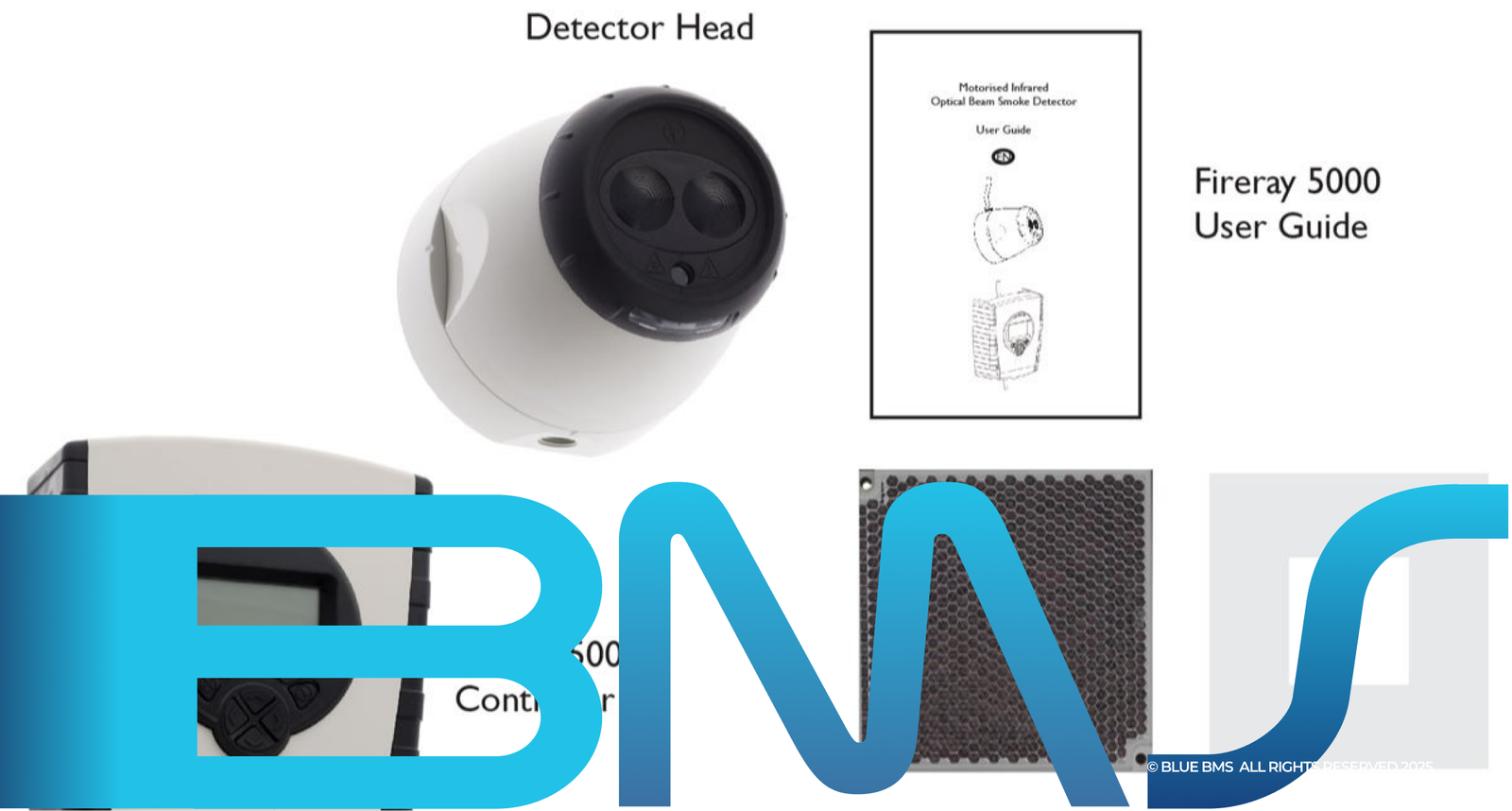
One example of such an advanced solution is the Fireray Beam Detector, which provides reliable coverage for extensive areas. For detailed specifications and to integrate this technology into your Building Management System, you can view the product information here: https://bluebms.com/product/fireray-3000-beam-smoke-detector-5-120-m/
6. Technical Reference Table
| BMS Component or Feature | Relevance to Fire/Smoke Detection | Source Reference |
|---|---|---|
| Building Management System (BMS) | Automatic centralized control, responsible for safety and security integration. | |
| BMS Response to Fire | Closes ventilation dampers, shuts down air handlers, and sends elevators to the ground floor. | |
| Sensor Types | Sensors collect data on smoke presence and other environmental parameters. | |
| Integration Method | Fire alarm systems are interfaced through hard wiring using volt-free contacts. | |
| BMS Maintenance Risk | Proactive maintenance (predictive maintenance/FDD) prevents issues before they escalate, minimizing downtime. |
7. Frequently Asked Questions (FAQ)
Q1: How does a BMS utilize a smoke detector, such as a beam detector, during an emergency?
When a detector signals smoke or fire, the BMS, which is linked to the fire alarm panel, executes predetermined safety protocols. These actions typically include shutting down air handlers to prevent smoke from spreading and managing access points to facilitate effective response and evacuation. The BMS is often hard-wired to override other automation functions.
Q2: What are the primary objectives of integrating fire safety into a Building Management System?
The overall objectives of integrating fire safety and automation include ensuring the safe and efficient operation of the building and increasing security. This proactive integration allows for continuous monitoring, early detection of hazards, and the coordination of facility systems to minimize downtime and critical infrastructure disruptions.
Q3: Is the fire alarm system directly connected to the BMS?
The fire alarm panel and its related smoke alarm systems are usually hard-wired to override building automation. Integration is achieved through hard wiring using volt free contacts, which the BMS monitors as digital input signals.
Q4: What crucial steps are taken during the commissioning of a smoke detector integration?
During commissioning, it must be ensured that the installation of the components is complete and complies with the approved shop drawings. For interface testing, digital inputs must be proven by simulating the alarm (opening and closing the volt-free contacts) and monitoring the status on the operating terminal. This ensures that the system handles the status and fault alarms correctly.
Q5: What technical actions does the BMS take to prevent smoke from spreading via HVAC systems?
In the event of a fire, the fire alarm panel, through the BMS interface, will close ventilation dampers and shut down air handlers. This capability is critical for safety, as integration allows the BMS to effectively isolate the blaze.
Q6: Why are advanced detection systems, like beam detectors, necessary in large facilities?
In large projects with extensive mechanical, HVAC, and electrical systems, a BMS is most commonly implemented to manage energy demand and complexity. Advanced detection systems are required to monitor expansive spaces, providing the necessary data points that the BMS software requires for centralized monitoring and proactive management of potential issues before they escalate.